
Reduce repetitive handling
Start with regular loading and unloading, and leave operators free for changeovers, checks and recovery.
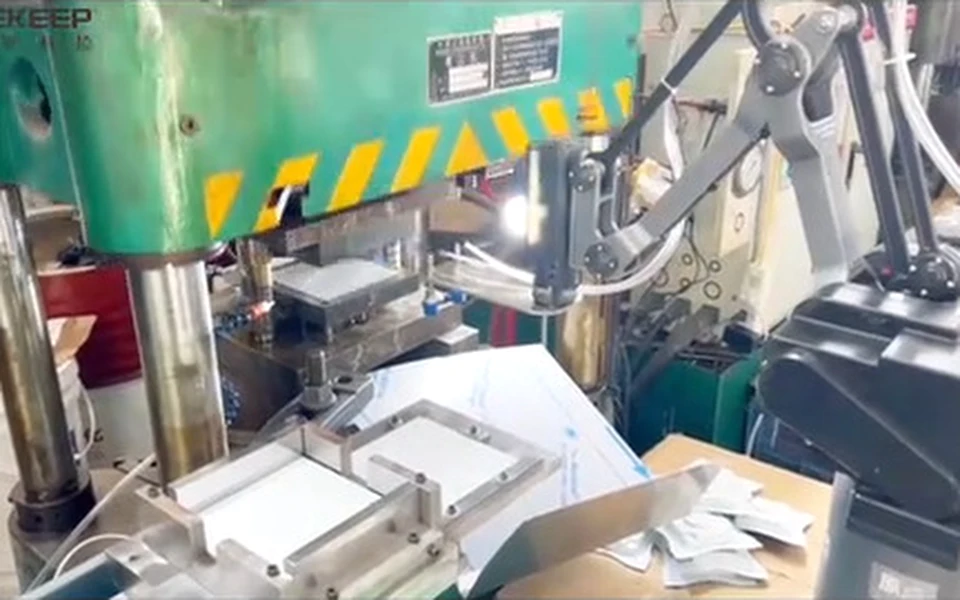
Metal Stamping Automation
Put a compact robot to work on repetitive loading and unloading. Start with one press and connect part feeding, pickup and downstream handling.
Look at where the cell waits for an operator, where placement varies and what slows the next changeover.
Start with regular loading and unloading, and leave operators free for changeovers, checks and recovery.
Trial your own blanks to assess feeding and gripping around oil, burrs, sticking and double-sheet pickup.
Check die and tray references on one press before extending the approach to multiple stations.
Connect feeding, the robot, tooling and the press around the way your parts move.
Choose a tray, locating fixture or feed system around part shape and stack behaviour.
Match tooling to the surface, centre of gravity and orientation. Verify grip and placement.
Use representative parts to check the full cycle, changeover and recovery after a stop.
Validate safeguarding separatelyThe press runs the forming cycle and the robot handles parts. A qualified team designs and validates independent safety controls, guarding and interlocks for the site.
Fixed-orientation handling, light part rotation or four-axis servo motion. Start with part and tooling weight and the space you need to reach.

MODEL: 3042H
Start with the 3042H for fixed-orientation transfers. Rated payload 2 kg, working radius 456 mm. Allow for tooling weight.

MODEL: 4042H
Consider the four-axis 4042H when parts need turning after pickup. Rated payload 1 kg, working radius 521 mm.

MODEL: 4060H
Consider the four-axis servo 4060H for orientation changes. Rated payload 1 kg, working radius 592 mm.
Explore small metal-parts press tending and a related smartphone cold-press installation to see how equipment handoffs come together.
See how small metal parts move from locating and pickup to the press handoff. Includes two workcell demonstrations.

See how robotic handling connects loading and unloading on a smartphone cold-press line, a related industrial process.
Prepare for a retrofit review with practical guidance on payload, axis count and machine signals.
Send a short cell video or tell us about your parts, machine and bottleneck. We can start with a single workstation.
Start with the machine condition, available interfaces, access and safeguarding. Confirm the responsibilities of the press and its independent safety system before deciding on a retrofit.
A fixed-orientation transfer is a candidate for three axes. Consider four axes if a part needs turning or reorientation. Check total payload, centre of gravity, reach and installation constraints.
Evaluate the full cycle, including feeding, grip confirmation, press travel, handoffs, waiting and safeguarding. Validate with representative parts and conditions.
Check that locating, gripping, die and tray changes are reliable across the variants. Tooling, process and acceptance criteria determine the degree of reuse.

