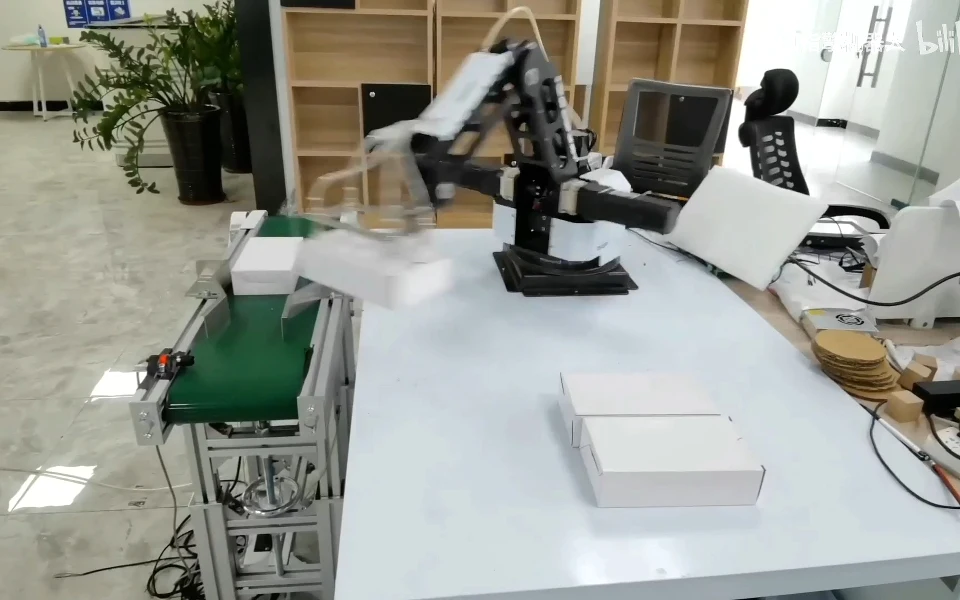
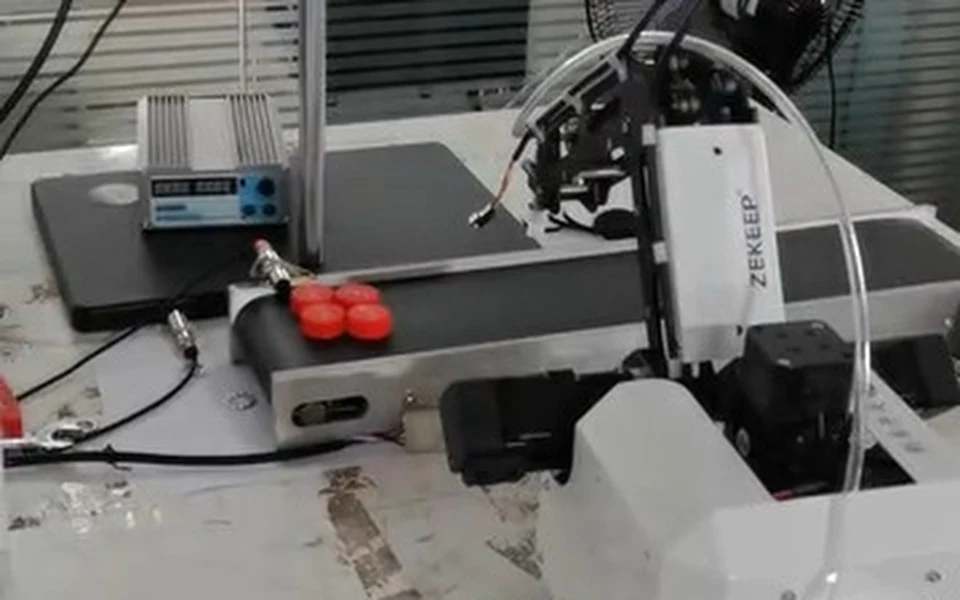
Two small-parts tending tasks can need quite different robots. One may work with three axes, another requires independent end rotation, and a third may remain unsuitable even after a fourth axis is added. Selection becomes confusing when axes, drive type, payload and teaching method are combined into a single question about which machine is more advanced.
A better sequence is to define the tool's approach and withdrawal, assess the complete load and working envelope, then compare drive and control arrangements under actual operating conditions. ZEKEEP's 3042H, 4042H, 3060H, 4060H, 3090H and 4090H provide different combinations for this task-based comparison.
Separate a position change from an orientation change
Moving between tray pockets does not necessarily require a change in tool direction. A task with many positions may still suit a three-axis candidate if the required tool direction remains compatible with its mechanism. Conversely, a two-position task can need independent end rotation because the receiving fixture imposes a different in-plane direction.
For these six models, adding independent end rotation is an important distinction between the three- and four-axis arrangements. A fourth axis does not imply arbitrary tilting or spatial inversion. Angled insertion, complex surface processing and multi-angle requirements need a fresh assessment of the available motion and process access, potentially involving another robot architecture or external mechanism.
Draw the source, destination, fixture openings and tool directions. Checking the complete entry and withdrawal is more useful than deciding axis count from the number of taught points.
Use the model table to shortlist candidates
| Model | Axes | Drive family | Rated payload | Maximum working radius |
|---|---|---|---|---|
| 3042H | 3 | Closed-loop stepper | 2 kg | 456 mm |
| 4042H | 4 | Closed-loop stepper | 1 kg | 521 mm |
| 3060H | 3 | Servo | 2 kg | 497 mm |
| 4060H | 4 | Servo | 1 kg | 592 mm |
| 3090H | 3 | Servo | 5 kg | 625 mm |
| 4090H | 4 | Servo | 3 kg | 717 mm |
For a constant-tool-direction transfer, a comparison might begin with the 3042H and 3060H, then include the 3090H where load and path justify it. Independent in-plane rotation directs attention to the 4042H, 4060H and 4090H. A 5 kg three-axis rating and a 3 kg four-axis rating describe different priorities rather than a simple performance ranking.
Payload includes tooling, adapters, valves and other moving components as well as the part. Being below the mass rating does not remove the need to check center of gravity, moments, inertia and acceleration. Maximum radius also does not establish usability at every height, posture and point within that distance. Validate the complete working envelope, including clearance moves.
Do not treat feedback as exclusive to servo drives
Closed-loop stepper systems also use feedback. Describing them as inherently feedback-free would misrepresent the comparison. Servo systems have different motor and control characteristics, but transmission, load, inertia, settings and motion organization all influence the complete robot's behavior. A motor category alone cannot promise production output or process quality.
A closed-loop stepper candidate may deserve assessment for a regular fixed-station transfer with suitable operating and waiting conditions. Where repeated acceleration, station timing or dynamic demands become more important, compare the selected servo configuration under the intended duty. These considerations guide testing; they do not replace model-specific application confirmation.
Break down the cycle before valuing a faster drive
A cycle includes approach, grip confirmation, withdrawal, travel, placement, release and waits for other equipment. If processing dominates, reducing travel time may have little effect on useful output. If handling is the constraint, tool response, path and acceleration should be examined together.
Compare candidates with consistent tooling, parts, paths and receiver conditions. Record acceptable output, waits, interruptions during continued operation and recovery effort. An unloaded demonstration is not directly comparable with another machine's complete loaded cycle. Frequent product changes also make recipe restoration, tooling changes and revalidation relevant to the decision.
Confirm teaching and interfaces separately
Pendant jogging, hand-guided teaching, PLC coordination and secondary development are different capabilities. The 3042H and 4042H do not support hand-guided teaching. Where it is needed, confirm the target servo model, controller and operating mode. A serial interface likewise does not establish support for every factory protocol, vision-tracking method or host application.
Budget for tooling, fixtures, sensing or vision where needed, installation, safeguarding and integration. A configuration that performs the task with manageable complexity, while leaving clear maintenance and expansion arrangements, is generally a better investment basis than axis count or maximum speed alone.
Mounting stiffness, base fixing and tool-cable routing also affect operating conditions. Check power provision, control-cabinet space and maintenance access before finalizing the layout.
Current product references are available for the 3042H, 4042H, 3060H, 4060H, 3090H and 4090H. The load, center-of-gravity and working-path guide develops the next checks. Share part drawings, the complete end tool, motion paths, orientation requirements and existing interfaces when discussing selection with ZEKEEP.