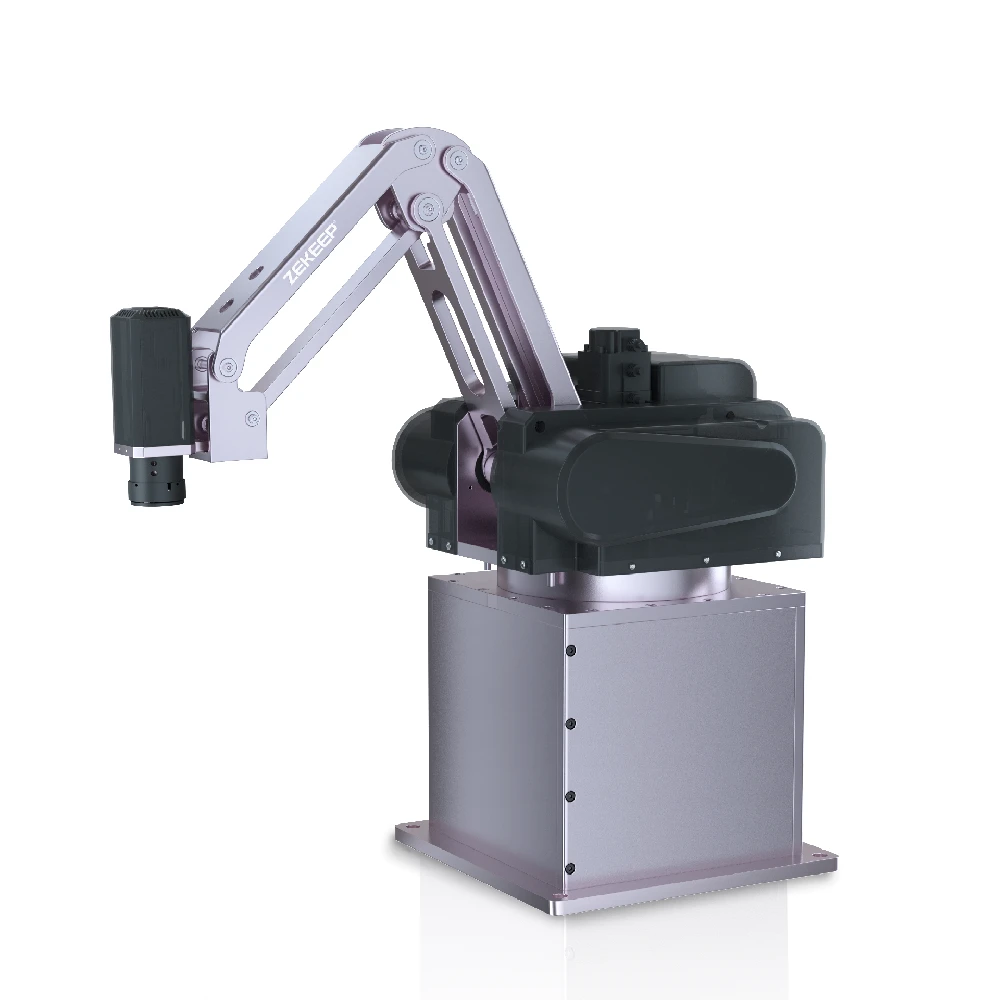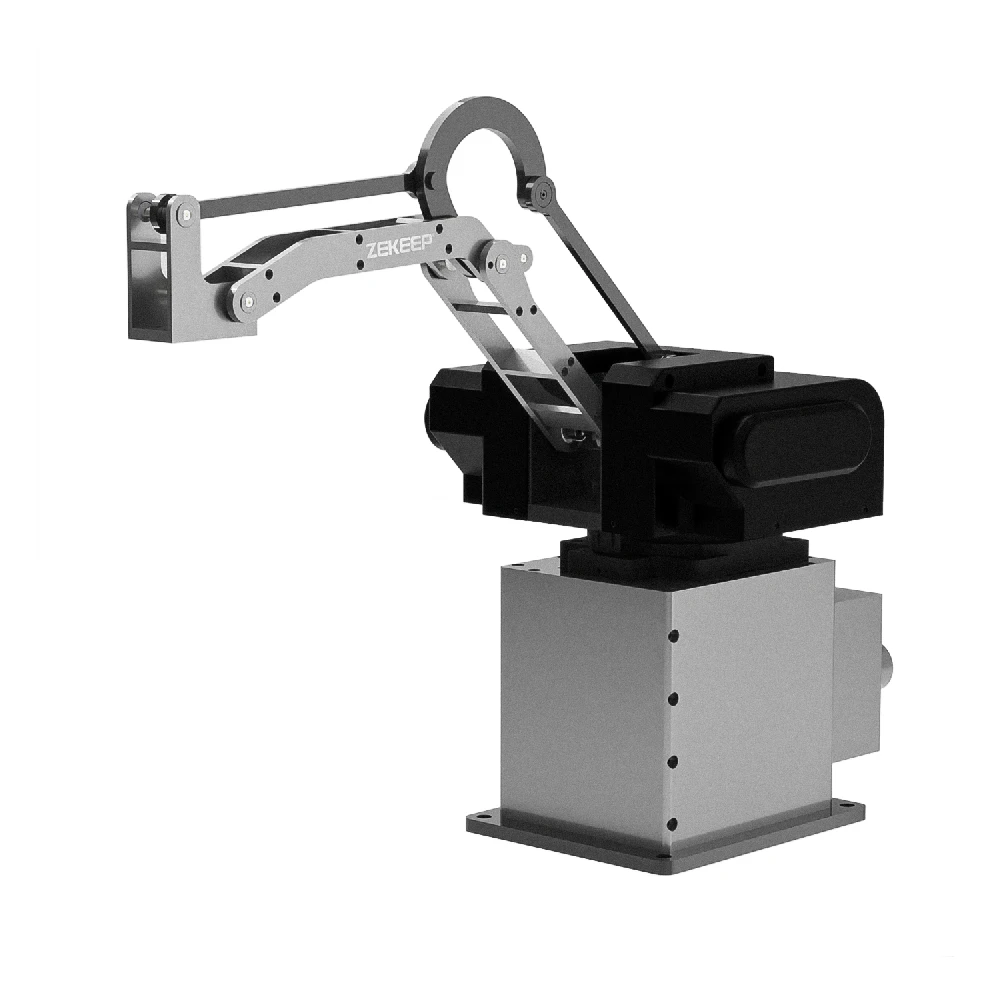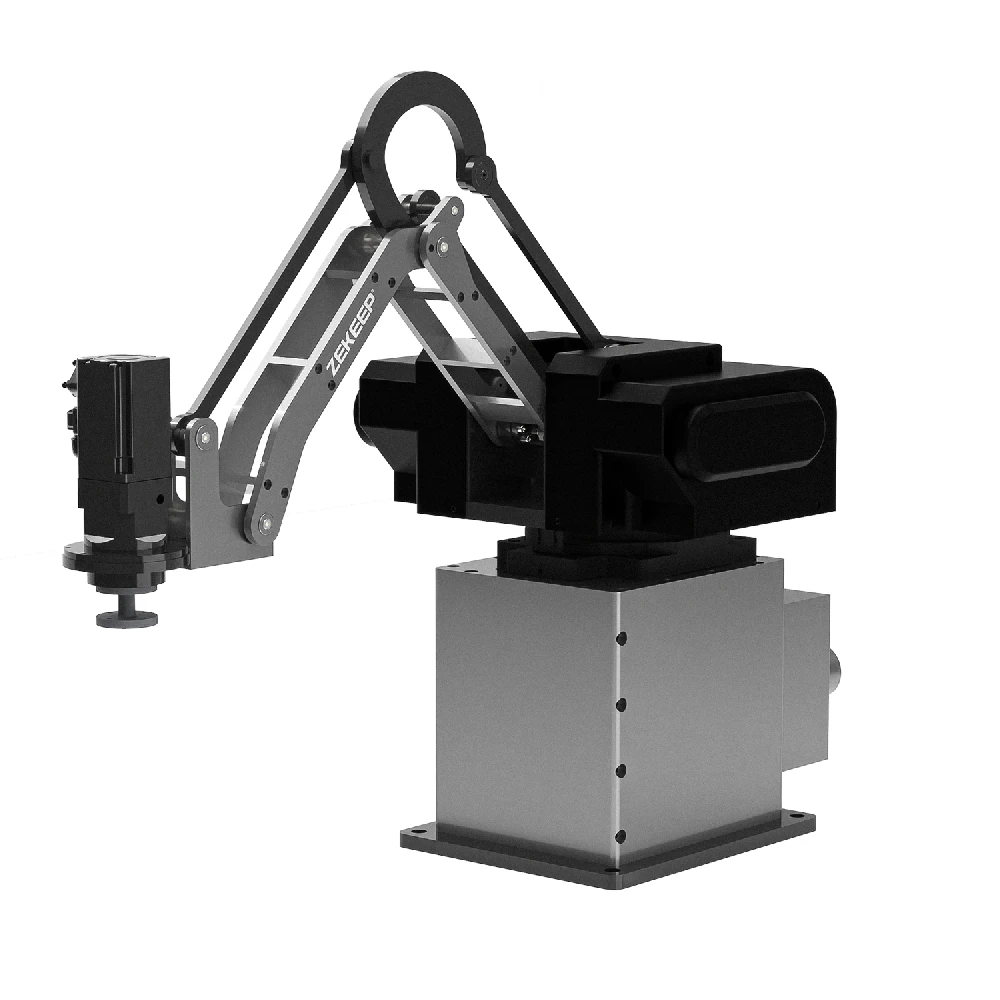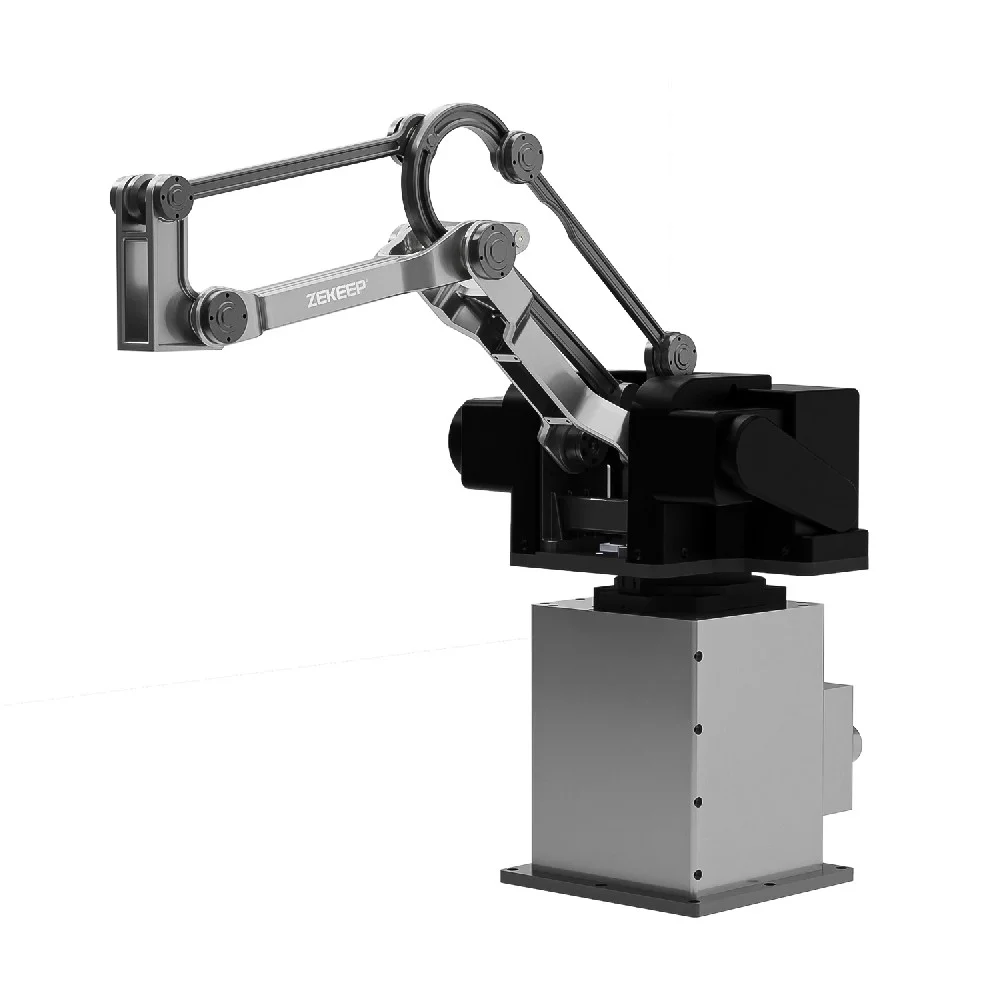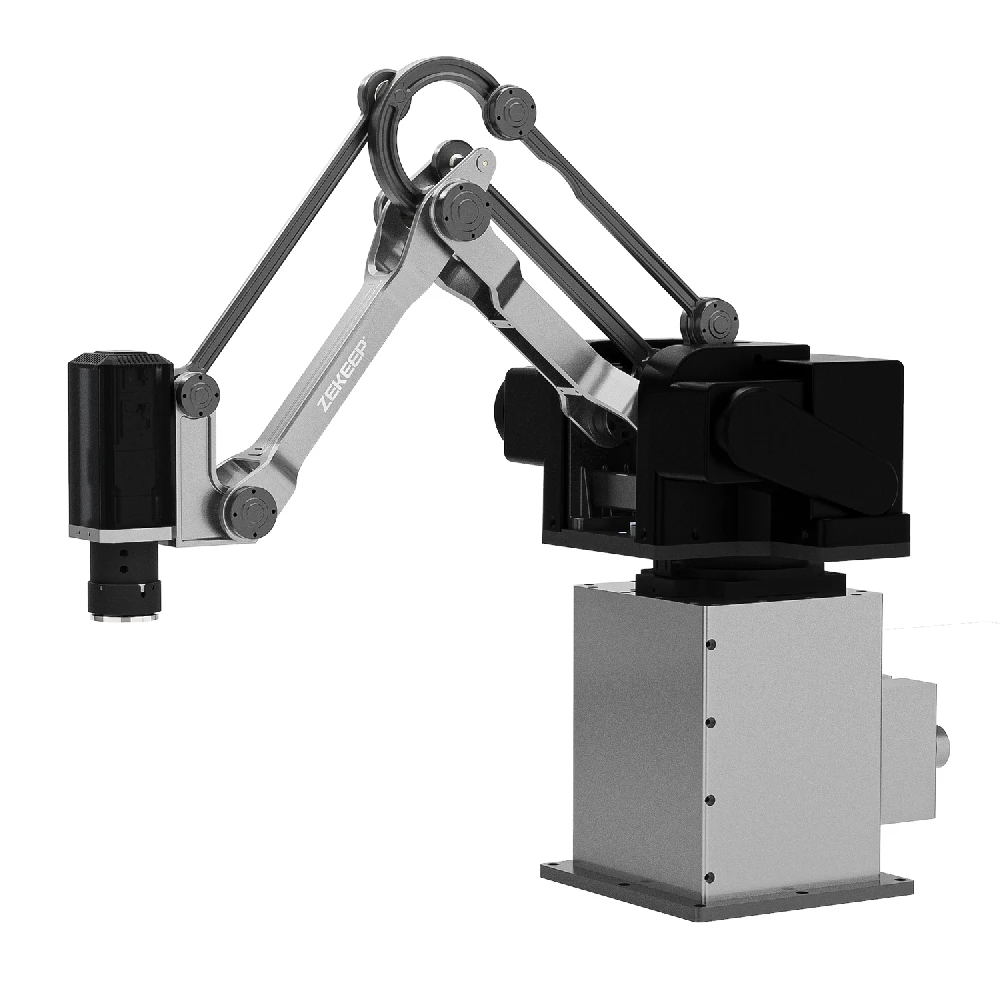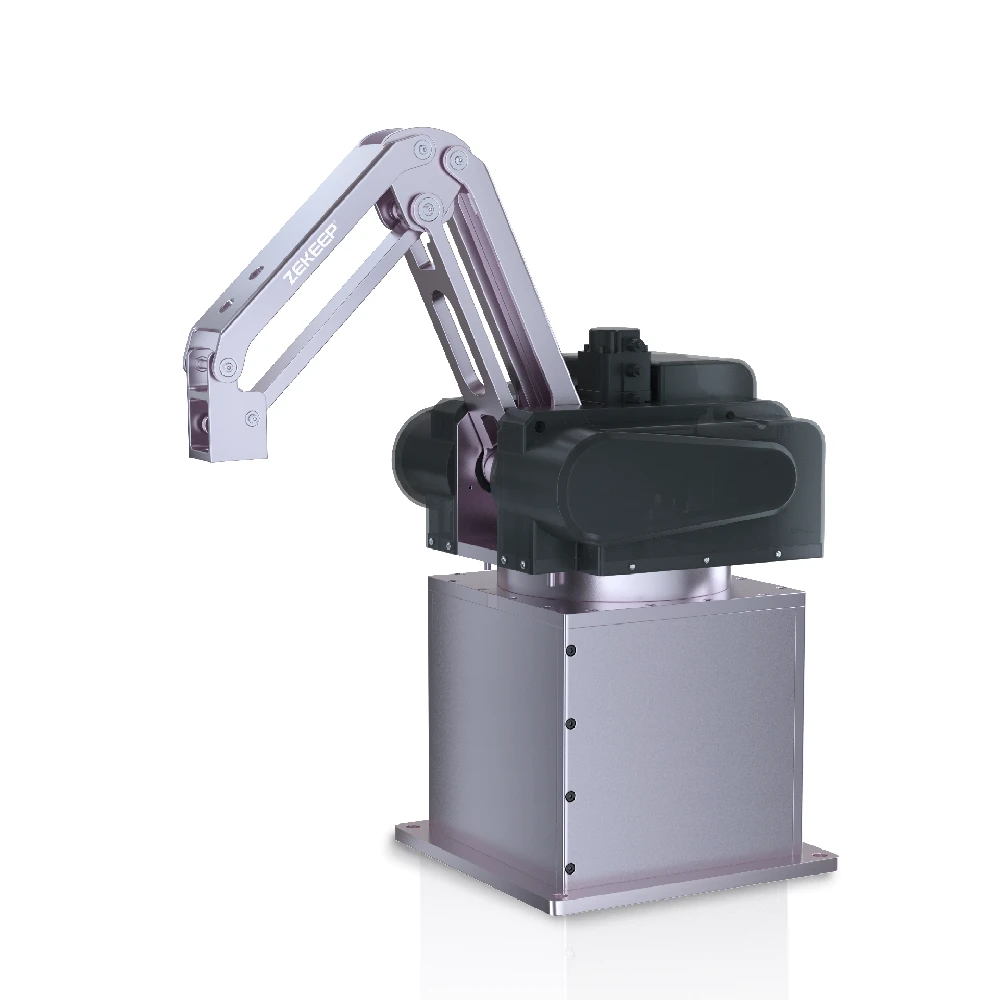
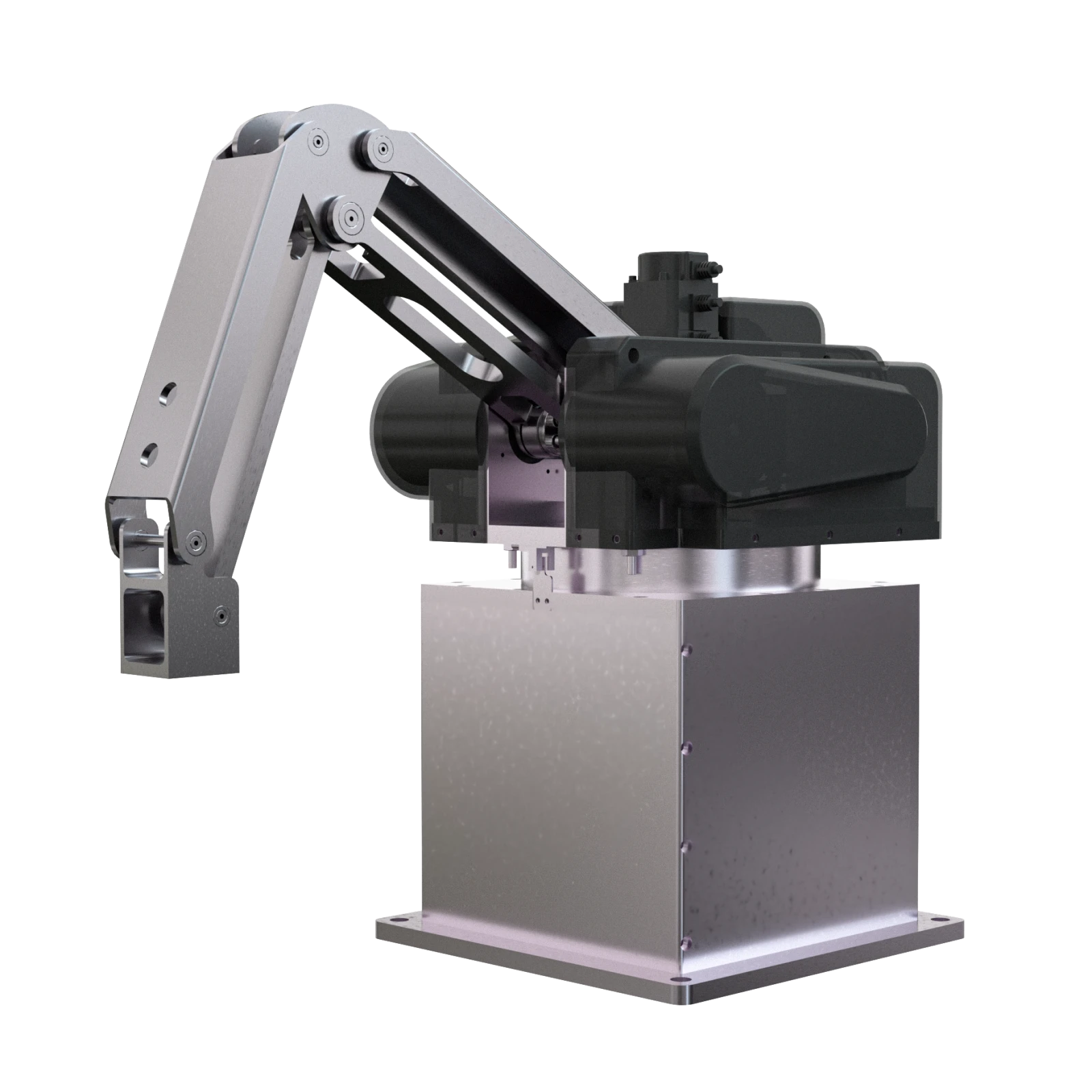
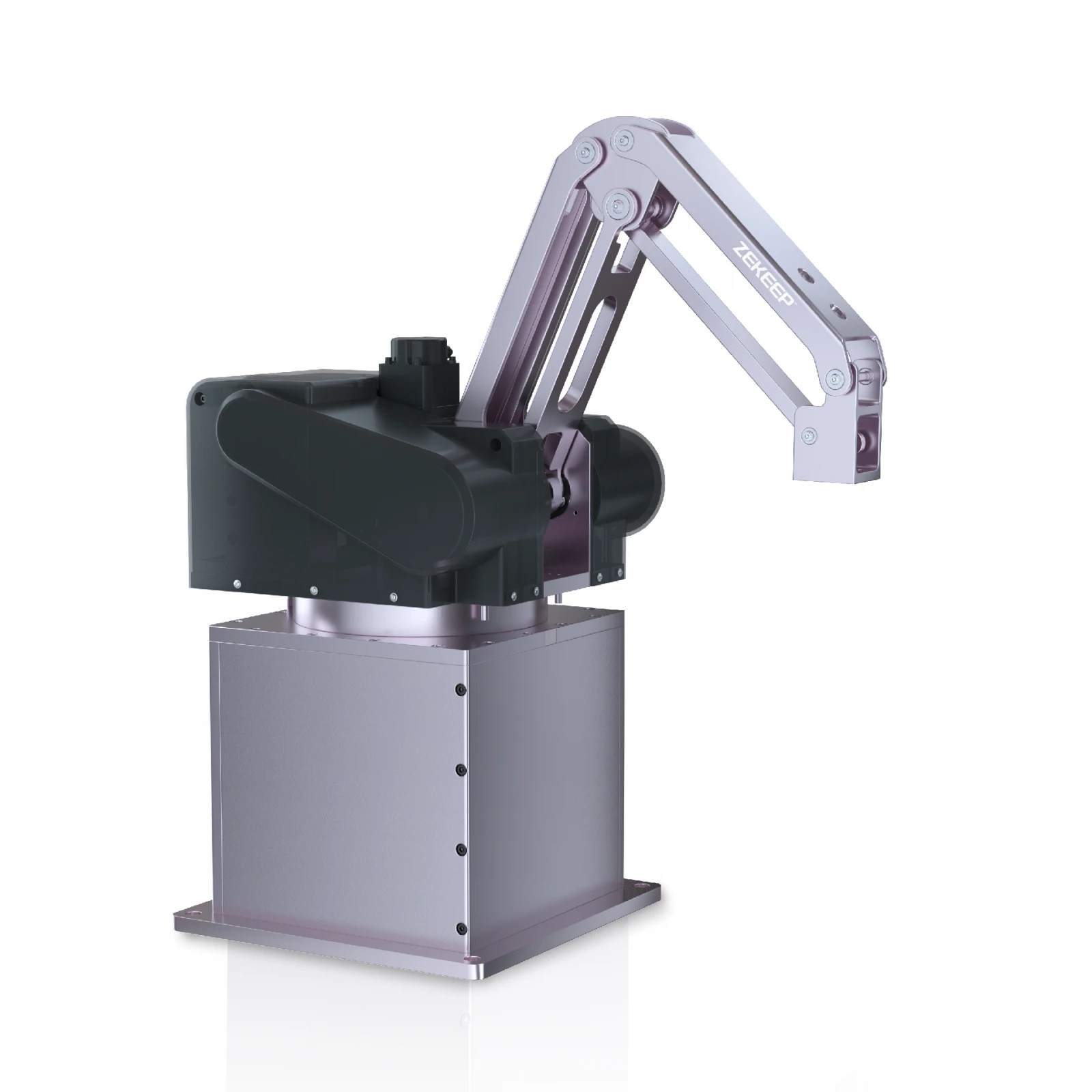
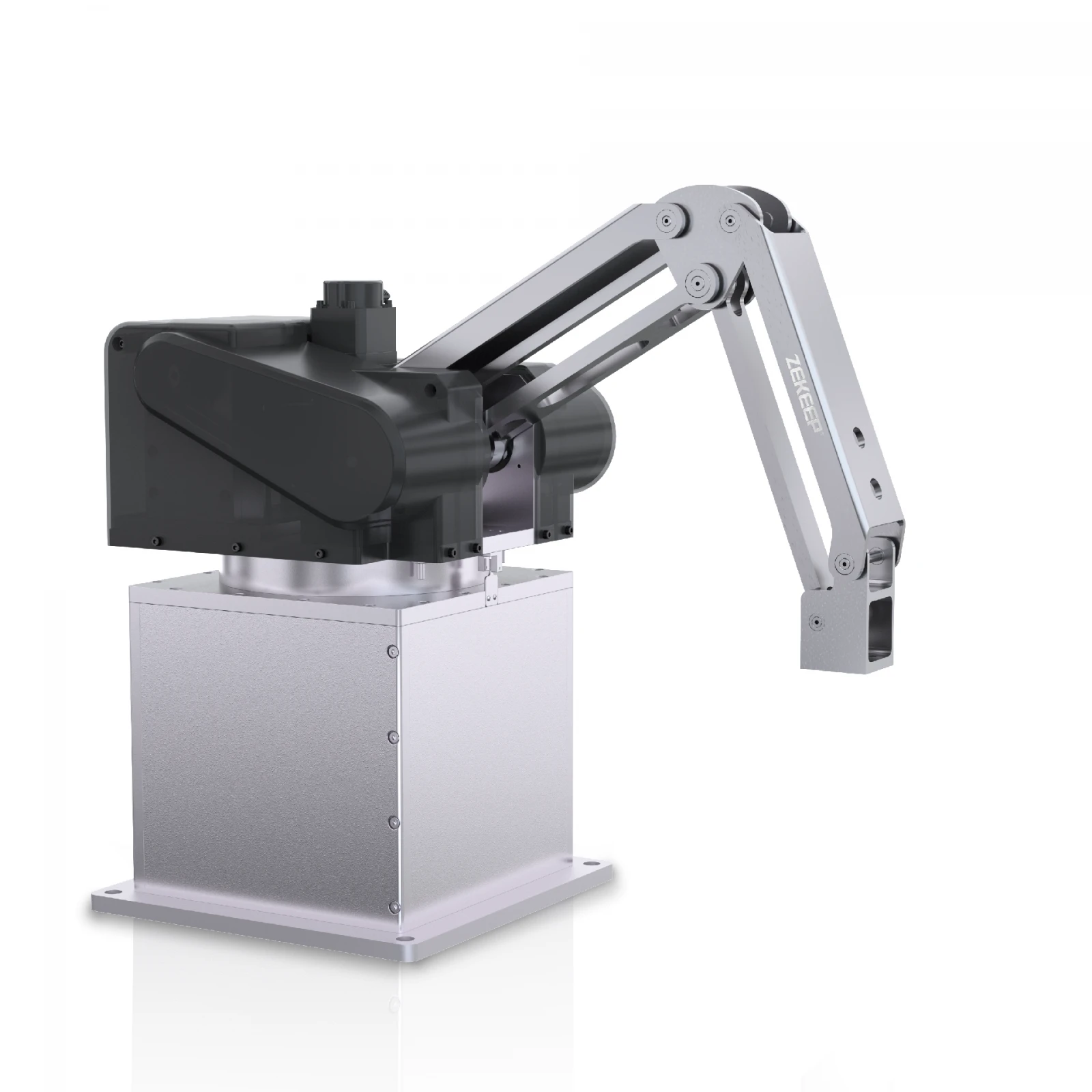
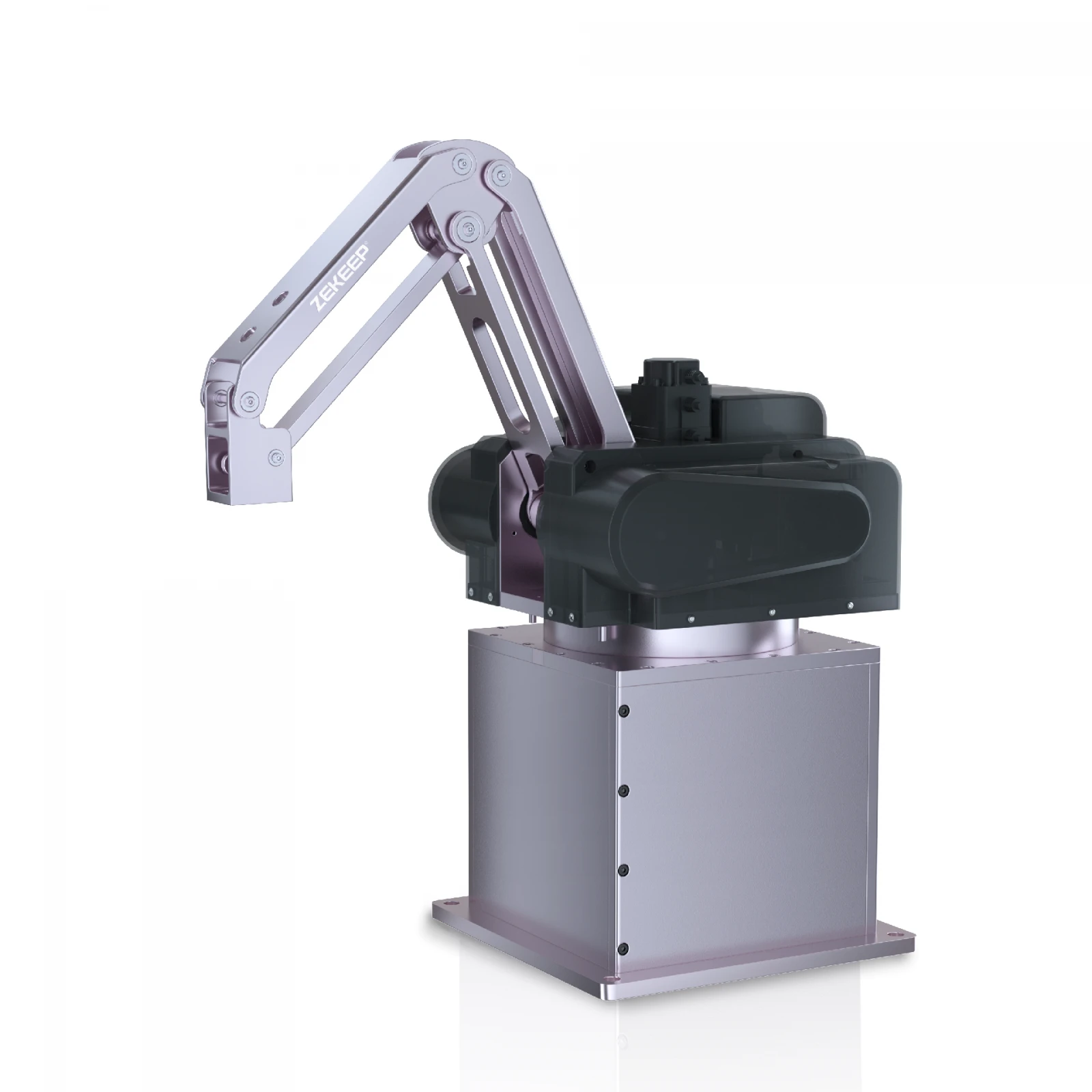
3042H 42H 3-axis closed-loop stepper industrial robot arm: 2 kg payload, 456 mm reach and ±0.05 mm repeatability. Maximum TCP point-to-point/linear speed: 1200/800 mm/s. Teach pendant programming with integrated drive and control; no hand-guided teaching. For machine tending, handling and palletizing.
Payload
2 KG
Reach
456mm
Repeatability
±0.05mm
Maximum Linear Speed
800mm/s
Build a compact workcell around a predictable motion. The 3042H handles fixed-orientation transfers, positioning and light stacking tasks where a fourth axis is unnecessary.
Budget the 2 kg payload for the workpiece and tooling together. Confirm the pickup position and feeding method when sizing the cell.
If the part must rotate at the tool, compare the 4042H. 4042H · Integration notes
2 kg Payload × ±0.05 mm Repeatability × Integrated Drive and Control — A Compact Solution for Lightweight Industrial Automation
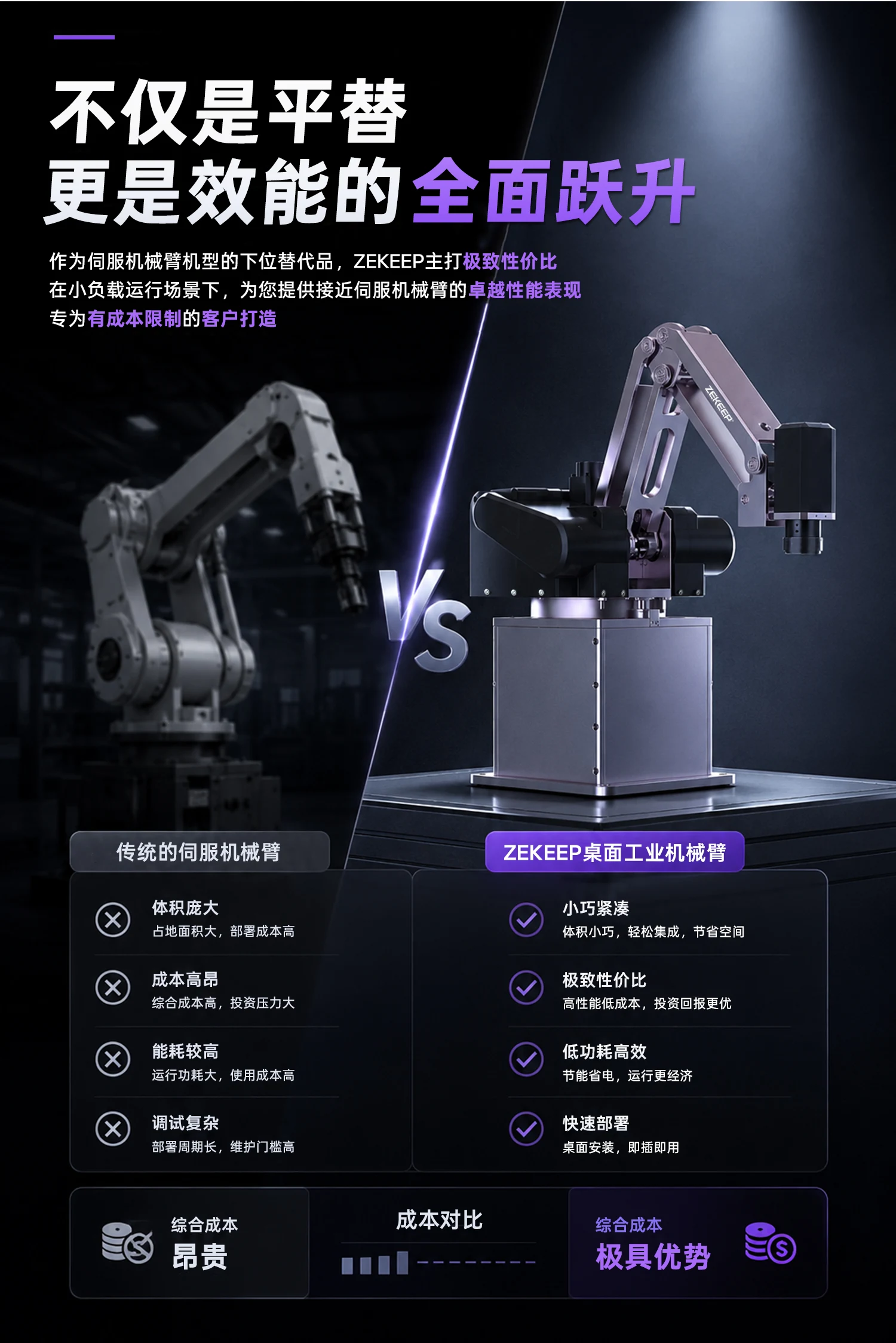
The ZEKEEP 3042H 3-Axis Closed-Loop Stepper Desktop Industrial Robot Arm is a compact robot designed for lightweight industrial automation. It features a 3-DOF joint structure, a hybrid servo stepper drive system, precision reduction mechanisms and an integrated drive and control architecture. It performs automated operations such as workpiece picking, handling, positioning and palletizing within a compact installation footprint.
The robot arm offers a rated payload of 2 kg, a maximum working radius of 456 mm and repeatability of ±0.05 mm. Its maximum TCP point-to-point speed is 1200 mm/s, while its maximum linear speed is 800 mm/s. Compared with the 4-axis version, the 3-axis configuration does not include an independent end-effector rotation joint, placing greater emphasis on payload capacity and basic picking and handling operations.
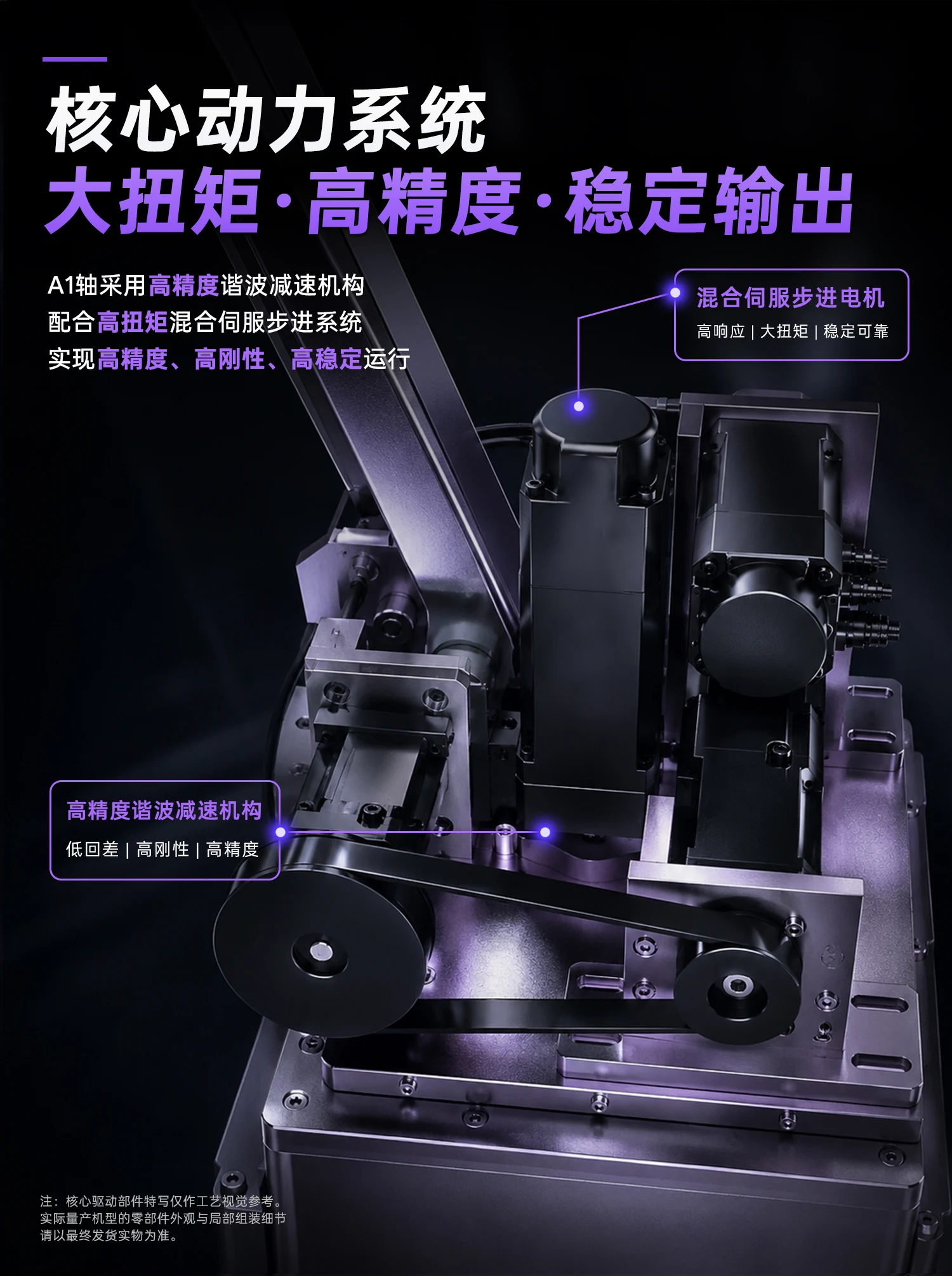
For its drive and transmission system, the robot uses 42 hybrid servo stepper motors, together with a harmonic drive reducer and helical gear reduction mechanisms. The combination of closed-loop motion control and mechanical reduction helps improve joint movement stability and positioning performance.
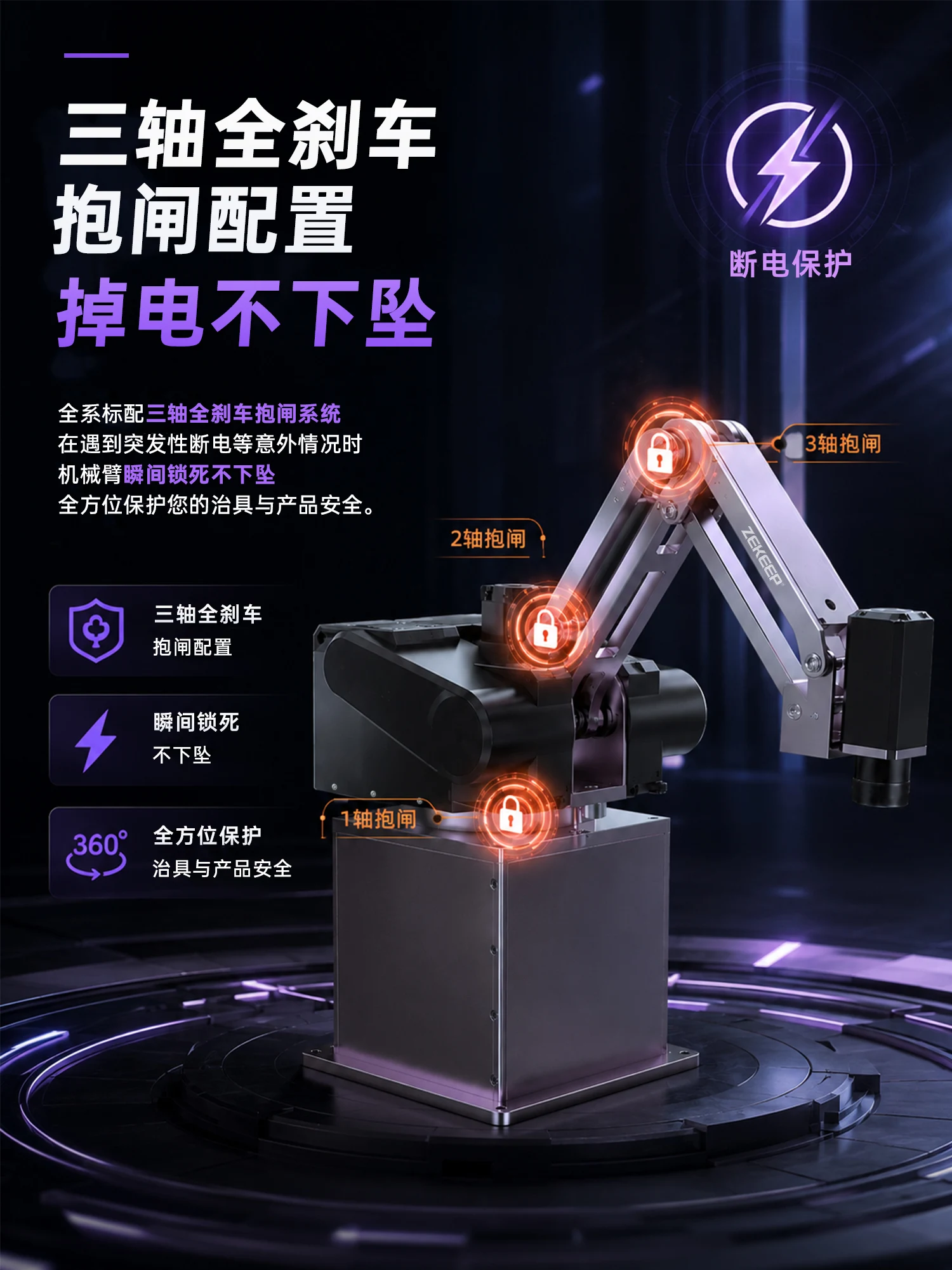
For safety protection, the robot is equipped with a braking system on all three axes. In situations such as sudden power loss, the brakes provide holding protection for the joints, helping reduce the risk of the robot arm dropping under its own weight or the workpiece being accidentally released.
For operation and control, the 3042H supports teach pendant programming. It provides motion functions including point-to-point, linear, joint offset, linear offset, circular arc and palletizing movements. It also supports joint and world coordinate systems, and includes 10 digital inputs (DI) and 10 digital outputs (DO) for peripheral device connectivity and compact automation system integration.
The robot features an integrated drive and control architecture, eliminating the need for a separate control cabinet. With reference dimensions of as shown in the current model dimensional drawing and a robot arm weight of approximately 16 kg, it is suitable for deployment on desktop workbenches, within compact assembly units and inside automated equipment.
For applications primarily involving repetitive picking, material transfer, positioning assembly and array palletizing, the 3042H provides a flexible industrial automation option with higher rated payload capacity and a compact structural design.
A higher-payload configuration designed to accommodate a wider range of workpiece handling tasks.
The 3042H has a rated payload of 2 kg and a maximum working radius of 456 mm. It can perform picking, handling and placement tasks for lightweight workpieces that meet its payload and working envelope requirements.
Compared with the 1 kg 4-axis version in the same series, the 3-axis model places greater emphasis on rated payload capacity, making it suitable for applications focused on material transfer and repetitive picking.
Combining stepper motor drive technology with closed-loop control to balance precision and power output.
The robot arm uses three 42 hybrid servo stepper motors, together with the corresponding drive and control system, to coordinate the movement of its joints.
Closed-loop control helps improve the control performance of open-loop stepper systems under changing loads and during motion, making it suitable for lightweight automation applications that require consistent repetitive operation.
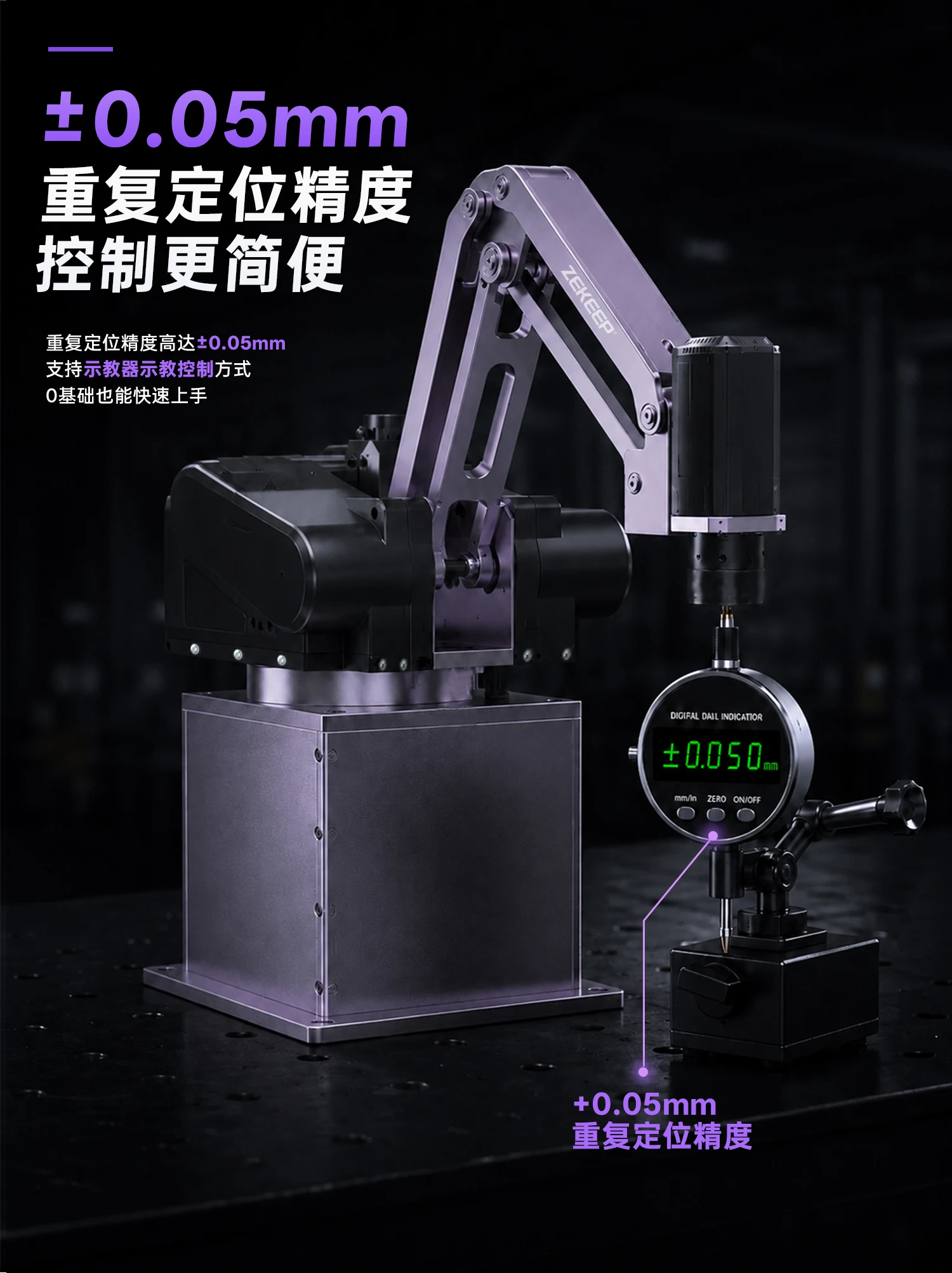
Accurate positioning for more consistent workpiece picking and placement.
The robot arm has a repeatability specification of ±0.05 mm and can be used for repetitive picking, positioning and placement of small workpieces.
Combined with its mechanical structure, reduction transmission and motion control system, this helps improve consistency in repetitive operations.
A coordinated transmission configuration that balances rigidity and motion performance.
The robot uses harmonic and helical gear reduction mechanisms, with a high-precision harmonic drive reducer configured on the A1 axis.
Combined with the hybrid servo stepper drive system, this configuration balances joint transmission rigidity, torque output and motion stability to meet the operating requirements of a 3-axis robot arm.
All three joints are equipped with braking systems to help reduce the risk of movement after power loss.
The 3042H comes standard with a braking system on all three axes. In situations such as sudden power loss, the brakes can provide holding protection for the corresponding joints.
This helps reduce the risk of the robot arm dropping under its own weight and workpieces falling from the end effector, adding an additional layer of equipment protection.
Establish basic operating sequences quickly without requiring complex programming.
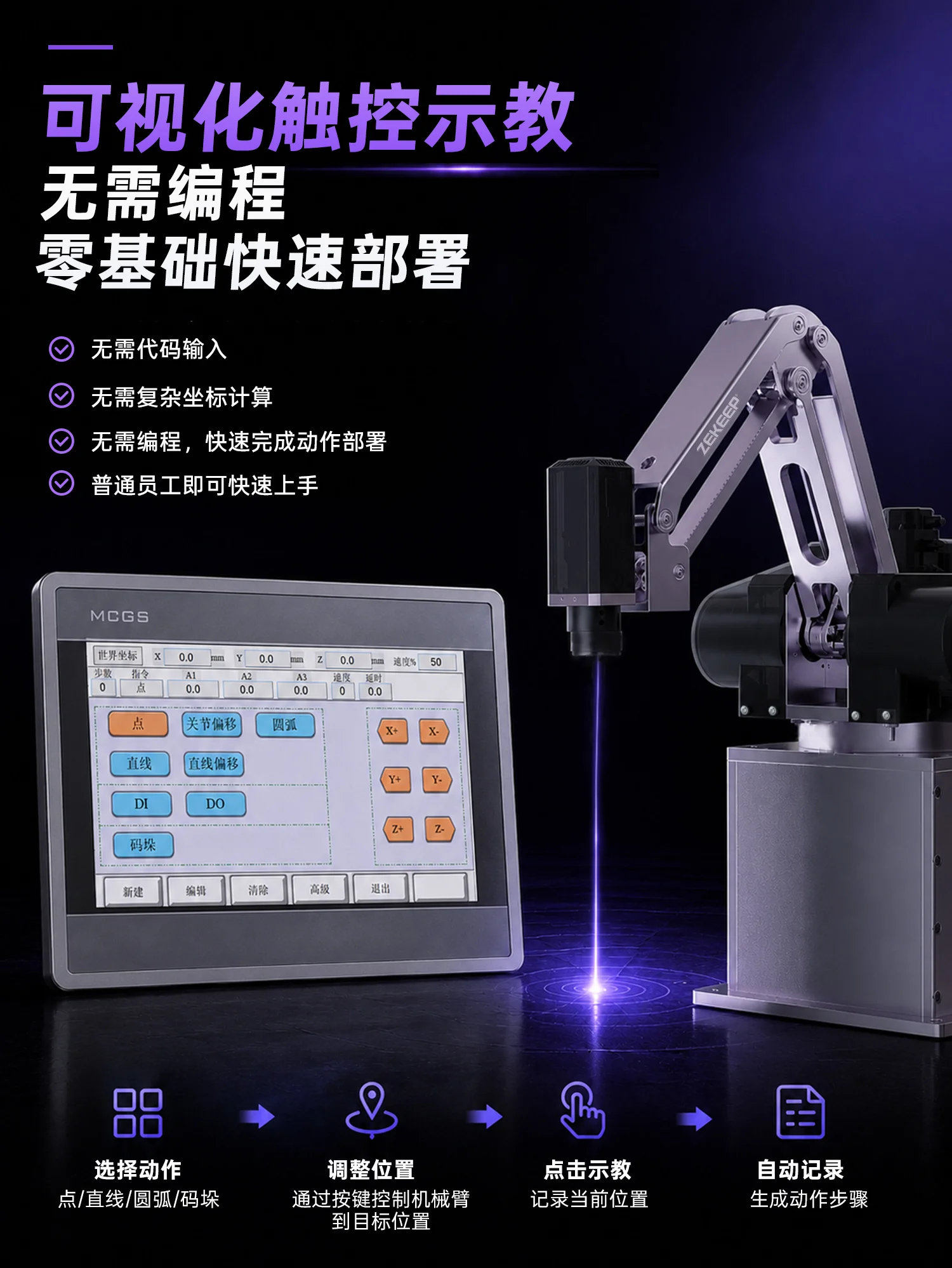
The robot supports teach pendant programming. Motion sequences can be created by selecting a motion type, adjusting the robot arm position and recording teaching points.
This is suitable for repetitive tasks such as basic picking, handling and palletizing, helping reduce the difficulty of equipment operation and basic deployment.
No separate control cabinet is required, allowing more flexible desktop deployment.
The robot uses an integrated drive and control architecture, with the relevant components incorporated into the base structure. This reduces the additional space required by a conventional separate control cabinet.
With reference dimensions of as shown in the current model dimensional drawing, it is convenient to deploy on desktop workbenches and within compact automation equipment.
Point-to-point, linear, circular arc and palletizing motion for different operating paths.
The robot supports point-to-point, linear, joint offset, linear offset, circular arc and palletizing trajectories. It also supports joint and world coordinate systems.
Motion sequences can be created through the teach pendant for applications such as workpiece picking, position transfer, repetitive placement and array palletizing.
Digital I/O interfaces support coordination with compact automation systems.
The robot is equipped with 10 digital inputs and 10 digital outputs, as well as a serial communication interface.
It can be connected to peripheral sensors, relays, conveyors and actuators for basic signal interaction, expanding its application possibilities in automated workstations.
A streamlined joint configuration focused on picking, handling and positioning capabilities.
The 3-axis version does not include an independent end-effector rotation joint, placing the structural emphasis on basic joint movement and payload capacity.
For applications that do not require independent end-effector rotation but place greater importance on workpiece handling capacity and repetitive material transfer, the 3-axis version provides a simplified mechanical configuration while meeting the required operating tasks.
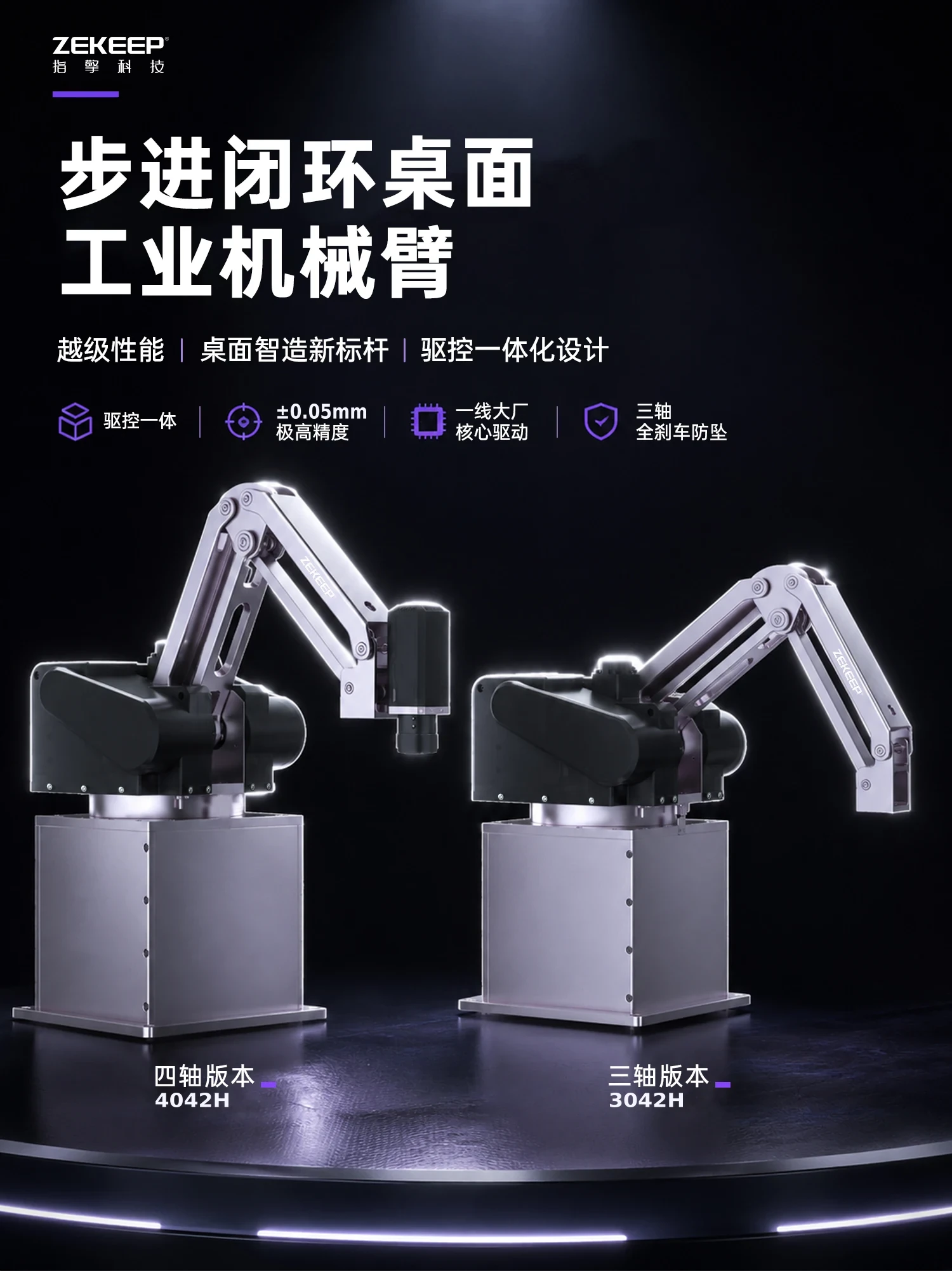
The 3042H is a 3-axis model in the ZEKEEP closed-loop stepper desktop industrial robot series. It uses 42 hybrid servo stepper motor drive technology and an integrated drive and control architecture. It is designed for automation applications such as lightweight picking, handling, positioning and palletizing.
The 3042H has a rated payload of 2 kg. It is suitable for picking and handling workpieces that meet the rated payload and actual operating conditions.
The product specification table lists a maximum working radius of 456 mm. The actual working envelope is also affected by robot posture, joint movement limits and installation position.
The product specifications list repeatability of ±0.05 mm. This supports small workpiece handling and automated positioning tasks that require consistent repetitive positioning.
The robot uses 42 hybrid servo stepper motors, with three motors configured across the three axes. It also incorporates a harmonic drive reducer and helical gear reduction mechanisms to provide closed-loop motion control.
Yes. The robot is equipped with a braking system on all three axes. In situations such as sudden power loss, the brakes can provide holding protection for the corresponding joints, helping reduce the risk of the robot arm dropping or workpieces falling.
It supports point-to-point, linear, joint offset, linear offset, circular arc and palletizing motion trajectories, as well as joint and world coordinate systems.
Users can adjust the robot arm position and record teaching points through the teach pendant to establish basic picking and handling sequences.
The robot is equipped with 10 digital inputs (DI) and 10 digital outputs (DO), as well as a serial communication interface. Depending on the actual control solution, it can exchange signals with peripheral sensors, relays and automation equipment.
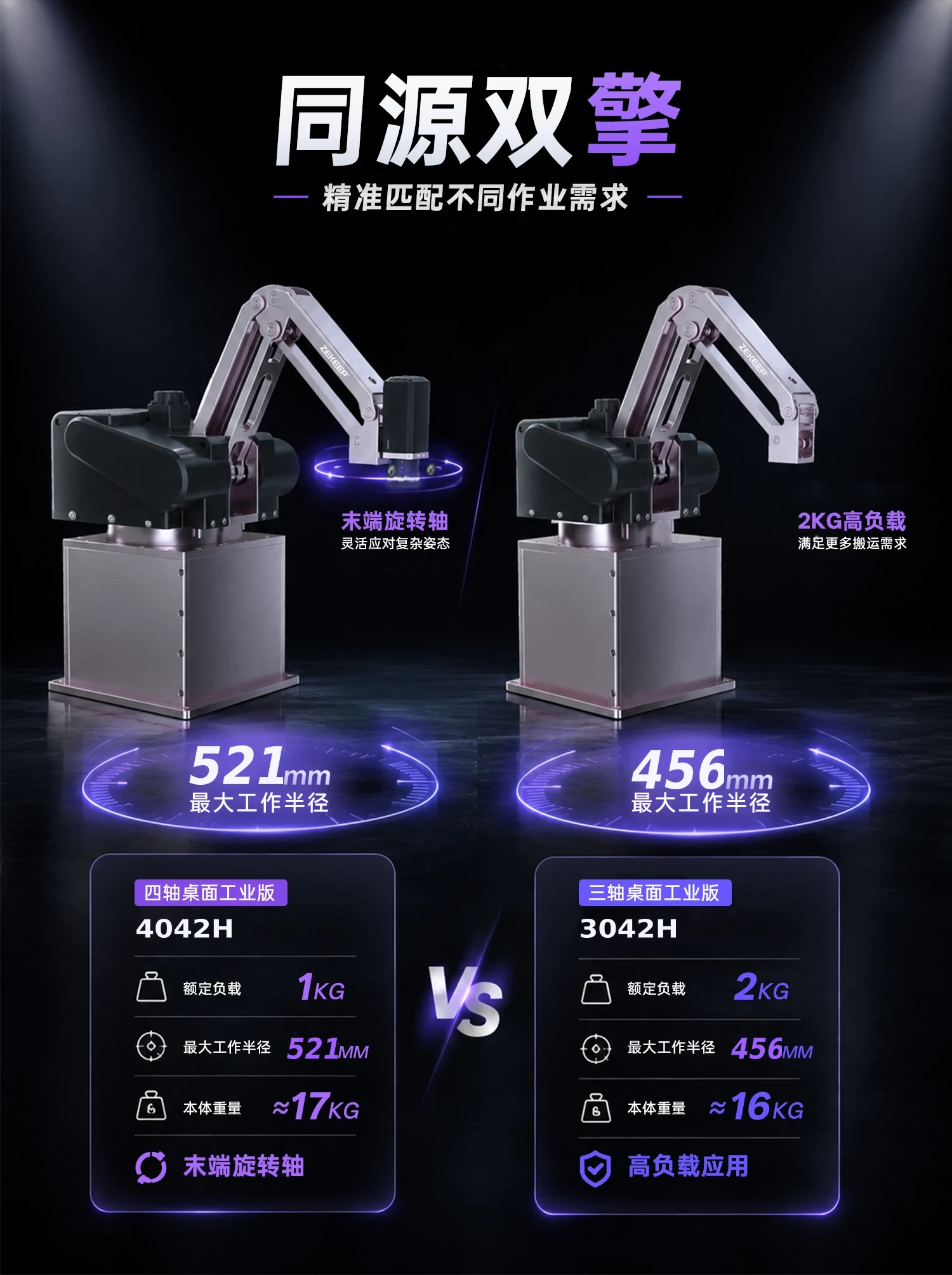
The 3-axis 3042H has a rated payload of 2 kg and a maximum working radius of 456 mm. It is primarily designed for picking, handling, positioning and palletizing tasks.
The 4-axis 4042H has a rated payload of 1 kg and a maximum working radius of 521 mm. It adds an independent end-effector rotation axis, making it suitable for applications that require adjustment of the end-effector or workpiece angle.
Choose the 3-axis version when payload capacity is the main priority. Choose the 4-axis version when independent end-effector orientation adjustment is required.
No. The robot uses an integrated drive and control architecture, with control components integrated into the robot arm base structure. This reduces the space required for a conventional separate control cabinet.
It is suitable for small workpiece picking, material handling, loading and unloading, positioning assembly, automated inspection and palletizing. Actual suitability should be determined according to workpiece weight, working space, end-effector configuration and process requirements.
To better match the robot configuration to actual automation requirements, we recommend clarifying the following information before selection:
Workpiece Information: Workpiece dimensions, weight, shape, material and gripping method.
Payload Requirements: Whether the combined weight of the workpiece and end effector meets the 2 kg rated payload limit.
Working Range: Picking height, placement positions, working radius and surrounding equipment layout.
Accuracy Requirements: Required repeatability and actual positioning accuracy for the process.
Control Requirements: Teach Pendant Programming, serial communication and external DI/DO connectivity.
End-Effector Configuration: Whether an electric gripper, vacuum suction cup or other customized end effector is required.
Safety Requirements: Brake protection, peripheral safety protection and emergency stop interlocking requirements.
System Integration: Whether connection to sensors, PLCs, conveyors and other automation systems is required.
Based on workpiece payload, working range and process requirements, the 3-axis robot arm, end effector, control interfaces and peripheral equipment configuration can be further determined to develop a desktop automation workstation solution that meets actual production requirements.
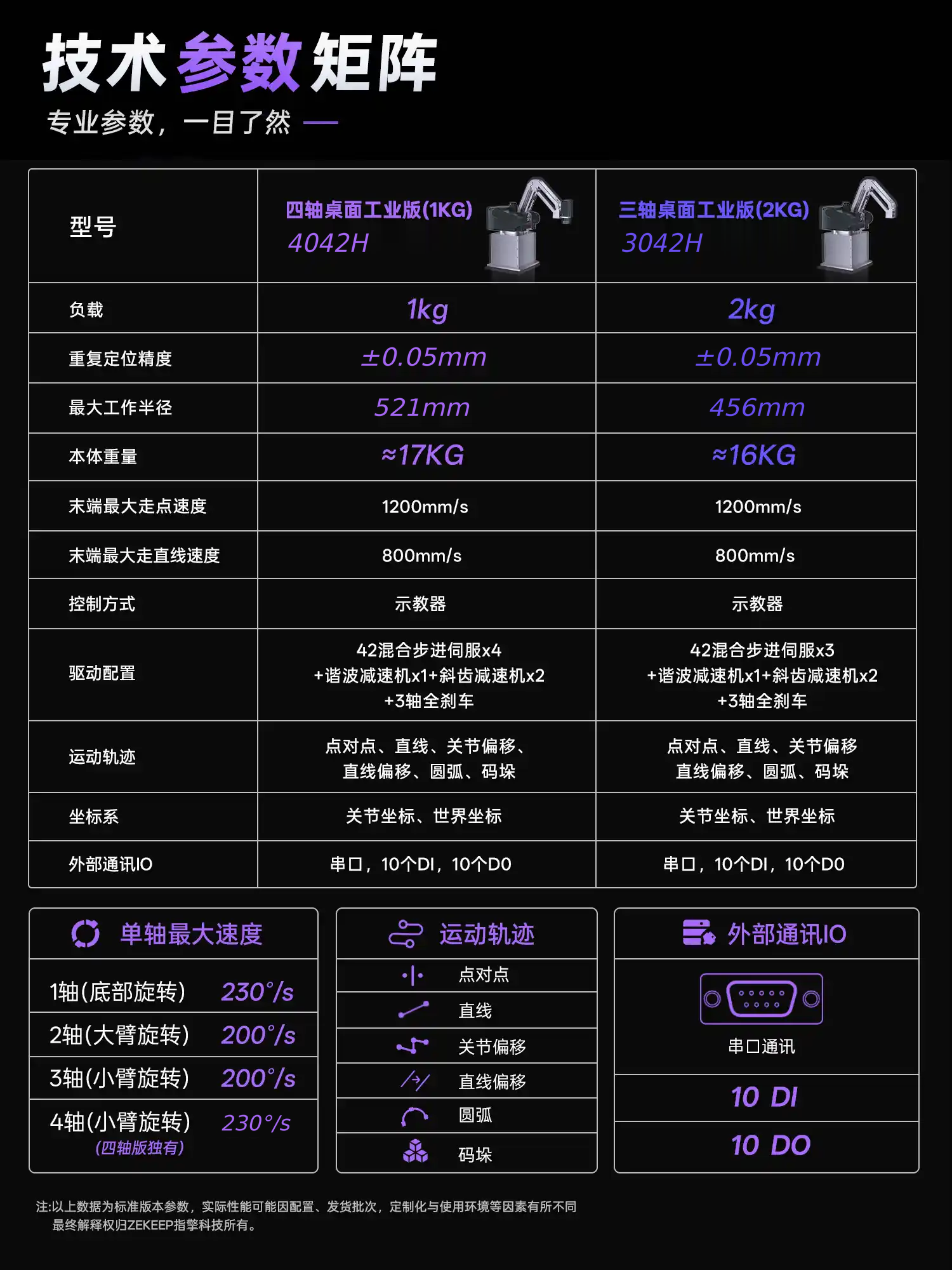
| Parameter | Specification |
|---|---|
| Model | 3042H |
| Series | 42H |
| Degrees of freedom | 3 |
| Rated payload | 2 kg |
| Working radius | 456 mm |
| Maximum effective stroke | 300 mm |
| Repeatability | ±0.05 mm |
| Maximum TCP point-to-point speed | 1200 mm/s |
| Maximum TCP linear speed | 800 mm/s |
| Maximum power consumption | 200 W |
| Robot weight | 16 kg |
| Motor configuration | 42 hybrid servo stepper ×3 |
| Reducer configuration | Harmonic ×1; precision helical ×2 |
| Brake configuration | Three-axis braking |
| Teach pendant programming | Supported |
| Hand-guided teaching | Not supported |
| Separate standard control cabinet | Not included; integrated drive and control |
| Power supply | AC220V / 110V |
| Operating voltage | 24V |
| Operating temperature | -10°C–50°C |
| Communication and I/O | Serial and USB serial; 10 DI / 10 DO; 24V / 0V digital signals |
| Motion trajectories | Point-to-point, linear, joint offset, linear offset, arc, palletizing |
| Coordinate systems | World and joint coordinates |
| Mounting | Floor or desktop |
| Standard delivery | Robot and 7-inch teach pendant |
| J1 maximum speed | 230°/s |
| J1 motion range | -162° to 162° |
| J2 maximum speed | 200°/s |
| J2 motion range | -90° to 0° |
| J3 maximum speed | 200°/s |
| J3 motion range | -108° to 0° |
| Joint Axis | Moving Component | Maximum Speed |
|---|---|---|
| J1 Axis | Base Rotation | 230°/s |
| J2 Axis | Upper Arm Rotation | 200°/s |
| J3 Axis | Forearm Rotation | 200°/s |
The 3-axis structure adjusts the end-effector position through the coordinated movement of the base, upper arm and forearm.
Unlike the 4-axis version, which adds an independent end-effector rotation axis, the 3042H focuses more on payload capacity and basic picking and handling operations. It does not provide an independent fourth-axis end-effector rotation function.
| Parameter | Specification / Details |
|---|---|
| Drive Motor Type | 42 hybrid servo stepper motors |
| Number of Motors | 3 |
| Drive Control Method | Closed-Loop Hybrid Servo Stepper Control |
| A1 Axis Transmission | 1 × Harmonic Drive Reducer |
| Other Transmission Mechanisms | 2 × Helical Gear Reducers |
| Brake System | Braking system on all three axes |
| Drive and Control Architecture | Integrated Drive and Control |
| Power System Characteristics | High torque, high precision, high rigidity and stable output |
| Structural Design | Compact integrated design |
| Key Advantages | Balances payload capacity, positioning accuracy and space efficiency |
The robot arm is driven by 42 hybrid servo stepper motors and uses a combination of a harmonic drive reducer and helical gear reduction mechanisms to balance joint torque output and transmission accuracy.
The three-axis braking system provides holding protection for the corresponding joints in situations such as sudden power loss, helping reduce the risk of the robot arm dropping under its own weight.
| Parameter | Specification / Details |
|---|---|
| Point-to-Point Motion | Supported |
| Linear Motion | Supported |
| Joint Offset | Supported |
| Linear Offset | Supported |
| Circular Arc Motion | Supported |
| Palletizing Motion | Supported |
| Joint Coordinate System | Supported |
| World Coordinate System | Supported |
| Maximum TCP Point-to-Point Speed | 1200 mm/s |
| Maximum Linear Speed | 800 mm/s |
| Position Teaching | Supported |
| Motion Recording | Supported |
| Basic Task Deployment | Supports creating motion sequences through teaching |
| Parameter | Specification / Details |
|---|---|
| Control Method | Teach Pendant Programming |
| Point-to-Point Operation | Supported |
| Linear Motion Operation | Supported |
| Circular Arc Operation | Supported |
| Joint Offset | Supported |
| Linear Offset | Supported |
| Palletizing Function | Supported |
| Coordinate Control | Joint Coordinates and World Coordinates |
| Motion Recording | Supported |
| Speed Adjustment | Motion speed can be configured through the teach pendant |
| Program Deployment | Supports rapid deployment of basic motion sequences |
The teach pendant features a graphical operating interface. Users can create motion sequences by selecting the motion type, adjusting the robot arm position, performing teaching operations and automatically recording motion points.
For basic picking, handling and palletizing tasks, this approach can reduce the need for complex coordinate calculations and program writing, making the robot easier to operate.
| Parameter | Specification / Details |
|---|---|
| Communication Interface | Serial Port |
| Digital Inputs (DI) | 10 channels |
| Digital Outputs (DO) | 10 channels |
| External Signal Control | Supported |
| Device Connectivity | Supports interaction with peripheral devices through I/O signals |
| Expansion Applications | Sensor signal input, actuator control and automation system integration |
The 10 DI / 10 DO digital I/O interfaces allow the robot arm to connect to external sensors, relays and actuators, making it easier to integrate the robot into compact automation workstations.
| Parameter | Specification / Details |
|---|---|
| Drive and Control Architecture | Integrated Drive and Control |
| Separate Control Cabinet | No separate control cabinet required |
| Robot Arm Weight | Approximately 16 kg |
| Mounting Method | Desktop Mounting |
| Deployment Characteristics | Compact structure, space-saving design and easy integration |
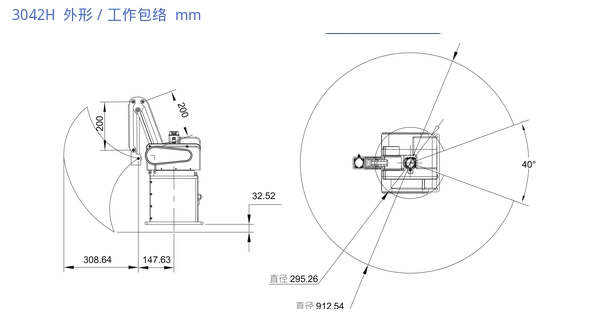
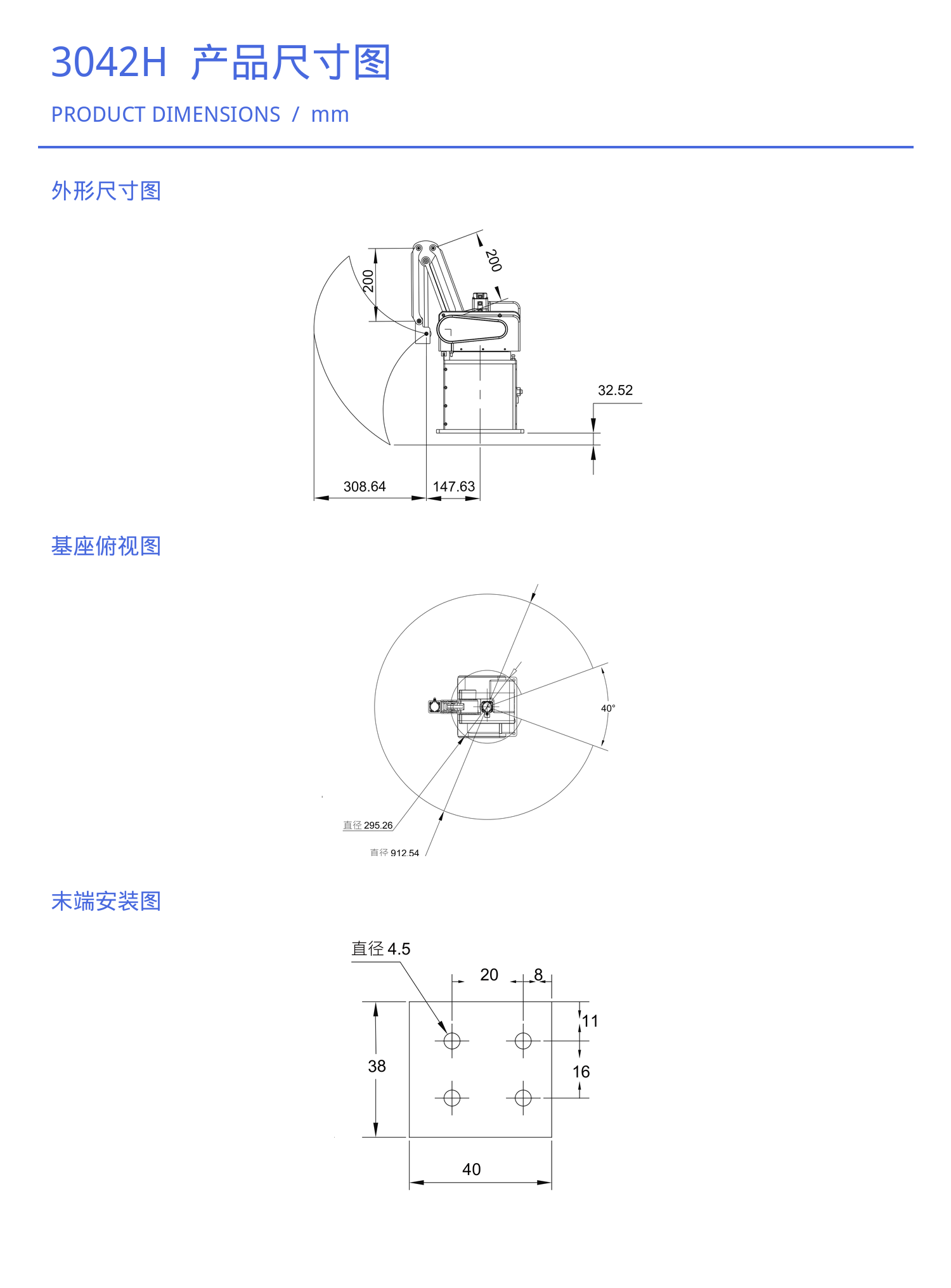
| Parameter | Specification |
|---|---|
| Working radius | 456 mm |
| Side-view horizontal dimension | 308.64 mm |
| Maximum outer diameter in drawing | Ø912.54 mm |
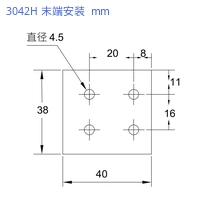
Use the 3042H dimensional drawing for mounting holes, end-flange details and structural dimensions. Reachable space depends on joint posture, end tooling and installation position; assess the workpiece and workstation layout before integration.
Suitable for automated picking and handling of electronic structural components, plastic parts, connectors and other lightweight components.
With a rated payload of 2 kg, the robot can perform loading, unloading, positioning and placement tasks for small workpieces, provided that the payload, working radius and gripper requirements are met.
Suitable for automated picking and placement, process transfer and positioning assembly of small components.
Using point-to-point, linear and circular arc motion trajectories, users can configure robot movement sequences according to assembly processes. Combined with external sensors and I/O signals, the robot can also coordinate with other workstation equipment.
Suitable for loading and unloading operations involving small processing machines, inspection equipment and automated production units.
By configuring pickup positions, placement positions and motion paths through the teach pendant, the robot can perform repetitive material transfer tasks and reduce manual handling operations.
Suitable for picking, transferring and sorting regularly shaped workpieces.
When integrated with external vision positioning systems, inspection equipment and control systems, the robot can support applications such as target position recognition, classified picking and designated-position placement according to the actual system configuration.
Suitable for palletizing small components, regularly shaped products and lightweight materials.
The built-in palletizing trajectory function allows users to configure product arrangement patterns and placement positions, enabling repetitive picking and array placement of multiple workpieces.
Suitable for practical training in industrial robotics, mechatronics, automation and smart manufacturing.
The robot can be used to study closed-loop stepper drive systems, robot motion control, trajectory planning, teach pendant operation and external I/O integration.
Suitable for automated production environments with limited equipment space, relatively light workpieces and flexible deployment requirements.
The compact integrated drive and control architecture reduces the space required for a separate control cabinet, making the robot easier to integrate into workbenches, small assembly units and automated inspection stations.
Operate the robot's three joints through the teach pendant to understand the movement relationships between the base, upper arm and forearm.
By adjusting joint positions and recording basic movements, users can learn the motion control principles of a 3-axis robot.
Configure pickup and placement positions according to workpiece weight, end-effector weight and available workspace.
The robot performs picking, movement and placement operations to carry out repetitive handling tasks for lightweight workpieces.
Set the robot's starting position, target position and motion sequence to establish a basic picking workflow using point-to-point motion.
Repeat operation and position adjustments can be used to verify positioning repeatability.
Configure linear and circular arc trajectories according to the required workpiece movement path, and observe the motion of the robot's end effector.
By adjusting paths and target positions, users can understand how different motion types are applied in automated operations.
Use joint offset and linear offset functions to modify existing positions or trajectories.
These functions can be used for workpiece position adjustments, pickup and placement path optimization, and motion adaptation between different workstations.
Configure the workpiece starting position, arrangement direction, placement spacing and palletizing sequence.
Use the palletizing trajectory function to perform continuous picking and regular arrangement of multiple workpieces, making it suitable for automated stacking of small components.
Select the motion type through the teach pendant, move the robot arm to the target position and record the teaching points.
Combined with automatic motion recording, this makes it possible to quickly establish robot picking and placement tasks while reducing the difficulty of basic application deployment.
Use the 10 DI and 10 DO interfaces for input signal detection and output control.
Together with external sensors, relays and peripheral actuators, the robot can be used for signal interaction experiments between the robot arm and automated equipment.
Study the basic principles of closed-loop drive control and mechanical brake protection through the hybrid servo stepper drive system and the braking configuration on all three axes.
Understand the relationship between motion control and power-loss protection to improve awareness of robot operating safety.
Combine workpiece picking, position adjustment, palletizing trajectories and I/O signal control to build a complete automated workflow.
Sensors, grippers, conveyors and other automation equipment can be connected according to actual process requirements to create an integrated compact workstation.
Leave your contact information and requirements. Based on the product specifications and application scenarios, we will provide preliminary selection and solution advice.