A 600 g component can make a 1 kg robot appear comfortably large enough. Add the gripper, adapter and sensors, however, and the tool assembly may already exceed that rating. Extending the tool to enter a machine can also change settling and rotation behaviour without changing total mass. Selection must address the complete moving load and task, not just the component listed on a purchasing form.
A useful decision sequence eliminates unsuitable options before validating candidates: establish moving mass, define orientation and space, examine centre of gravity and dynamic conditions, and finally test the real tooling in a complete cycle. This avoids both an undersized choice and an unsupported decision simply to buy a larger model.
Count the moving assembly, not only the part
Consider a 600 g component, a 450 g pneumatic gripper and a 150 g adapter:
0.60 + 0.45 + 0.15 = 1.20 kg.
This assembly exceeds a 1 kg rated payload. If lightweight tooling changes the design, recalculate and validate it; do not retain the original 600 g selection assumption. Include moving sensors, valves, fittings and every component picked in the same operation as applicable to the installation.
The 1.2 kg result is an initial mass estimate, not approval to use a 2 kg robot. The difference between a rating and the calculated mass is not automatically available under every posture and acceleration. Supply the end-tool drawing, centre of gravity and motion requirements for checking against the selected model's permitted conditions.
Define orientation before comparing axis counts
A transfer that preserves orientation differs from one that changes the part's in-plane direction. The former can start with a suitable three-axis configuration; the latter may require appropriate four-axis end rotation. Tilting, turnover or complex spatial insertion requires a separate assessment of degrees of freedom and fixtures. Additional taught points cannot create a missing axis.
ZEKEEP's current industrial documentation, dated 7 November 2026, supports the following initial comparison:
| Model | Axes and drive | Rated payload | Maximum working radius |
|---|---|---|---|
| 3042H | Three-axis, closed-loop stepper | 2 kg | 456 mm |
| 4042H | Four-axis, closed-loop stepper | 1 kg | 521 mm |
| 3060H | Three-axis, servo | 2 kg | 497 mm |
| 4060H | Four-axis, servo | 1 kg | 592 mm |
| 3090H | Three-axis, servo | 5 kg | 625 mm |
| 4090H | Four-axis, servo | 3 kg | 717 mm |
For the 1.2 kg example without independent end rotation, the 3042H and 3060H enter a three-axis candidate list, subject to further checks. In-plane rotation may lead to a comparison with a suitably rated four-axis option such as the 4090H. The 4060H's axis count does not override its 1 kg rating. A higher-load task may also justify assessment of the 3090H.
Equal mass does not mean equal loading
A more distant tool centre of gravity can increase gravitational moment about a relevant axis. For unchanged mass, doubling the perpendicular lever arm doubles that static gravity contribution. Rotational inertia also depends on the distribution of mass relative to the axis. A compact gripper and a long suction beam are therefore not equivalent merely because a scale shows the same number.
Robot posture, speed, acceleration, cycle frequency and forces from hoses or cables also affect the task. Where a published table provides payload alone, do not derive an allowable moment or inertia limit from it, or apply one universal “safety margin” to every model. Use assembly drawings or models with manufacturer-confirmed conditions and the intended program.
Compare drive choices under the same operating conditions
The 3042H and 3060H both have a 2 kg rating, but their drives, working ranges and application conditions differ. Compare closed-loop stepper and servo options using the same object, tool, path and cycle target. Short moves, acceleration, settling, repeated operation and peripheral waiting determine whether nominal motion differences matter to the workstation.
Programming methods also affect preparation. The 3042H and 4042H support teach-pendant programming but not hand-guided teaching. The listed servo series support pendant and hand-guided teaching. A convenient teaching method does not automatically generate the complete process or replace tool, interface and recovery commissioning.
Approve a complete cycle, not two reachable points
Check approach, lift, clearance, machine entry and withdrawal as well as pickup and placement. Maximum working radius is not usable space at every height and orientation. A layout containing the base, tool length, machine opening and fixture may reveal that a different feed direction solves the problem without a larger robot.
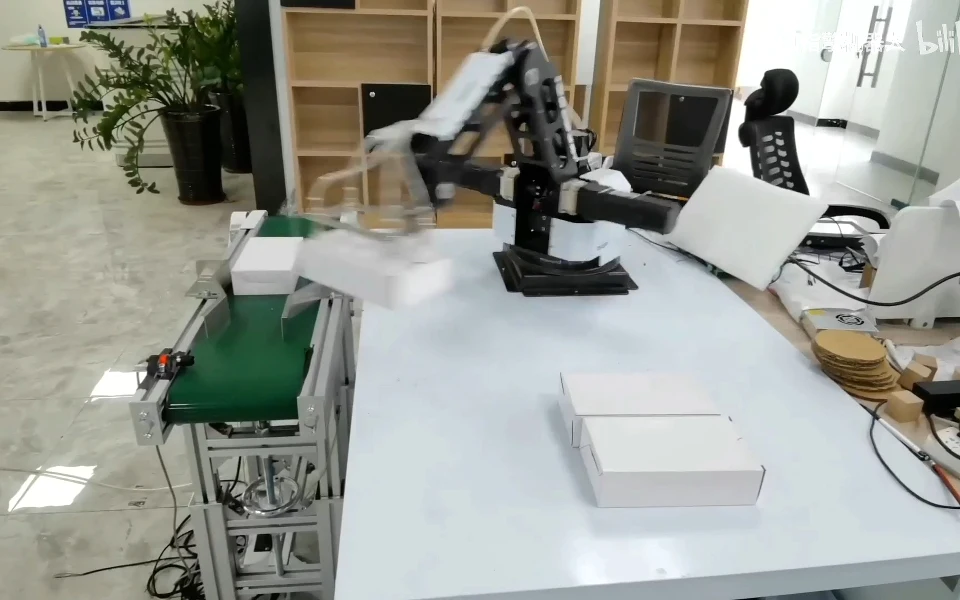
Separate motion, gripper response, signal checks, settling and machine waiting in cycle records. Use the intended tooling and representative parts to assess path, retention, placement and transfer. A motion demonstration helps explain mechanism behaviour; an unknown demonstrated load is not performance evidence for a current model.
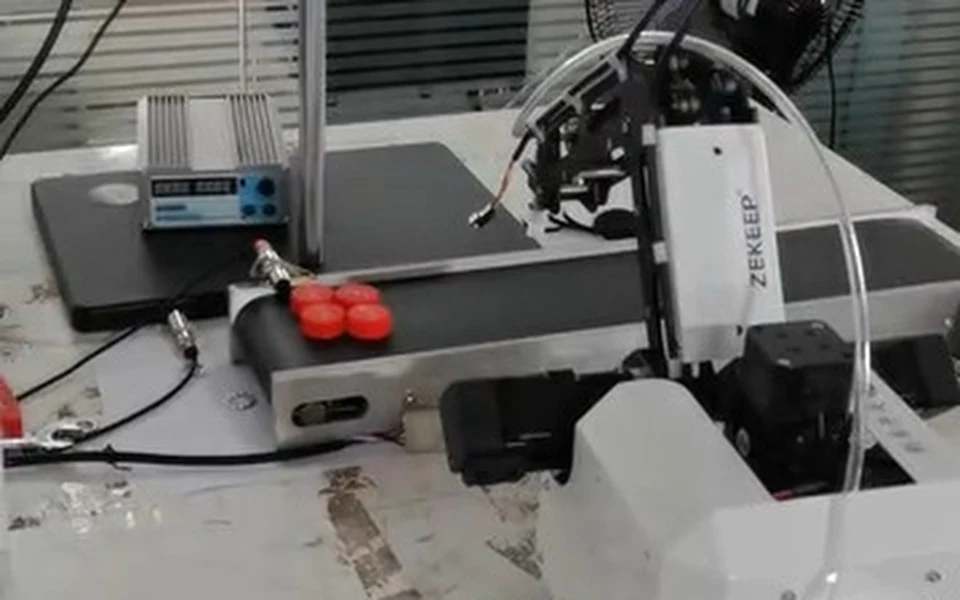
The multi-part end-tool concept illustrates why array tooling needs a complete mass assessment. Send ZEKEEP the selection inputs: end-tool list and drawing, part variation, orientation, layout and full cycle requirements. These establish a more useful candidate and validation plan than asking for a robot size from part mass alone.