Coordinate mobile arrival, robot reach, material references and exception recovery when planning a roller-conveyor handoff with a mobile manipulator.
Key Result 1
Key Result 2
Key Result 3
Material movement between production areas presents two different requirements: travelling the distance and performing the handoff. A transport vehicle can bring material close to a line without transferring it onto the equipment. A fixed robot can handle parts but remains tied to its installation. A mobile manipulator combines these functions, shifting the design question from a single move to a complete transfer: what happens after arrival?
A line-side concept can assign travel to the base, handling to the arm and a controlled receiving location to the conveyor, connected through explicit task states. The route, carrier and interfaces need to be integrated together. Bringing the platform to a stop is one part of preparing the handoff.
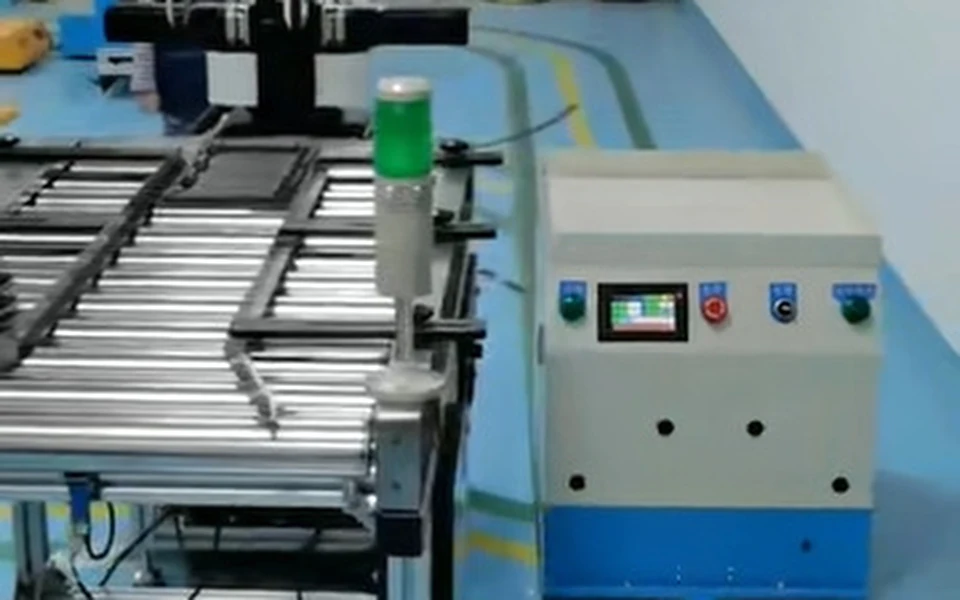
Establish which conveyor section receives material, the required orientation, and any stops or locating features. Fixtures, guides and the end tool should support that reference. A pallet, returnable container and directly gripped component need different handoff assessments; a demonstration with similar-looking material is not a substitute for the actual load.
Check the complete working envelope after docking. Can the arm approach in a usable orientation? Does the upper structure obstruct the tool? Is replenishment and maintenance access available? Evaluate the route from a travelling configuration into the workstation and back to a condition suitable for departure, not just reach at the final point.
Navigation establishes the platform’s position in the facility. The tool-to-part relationship also depends on docking angle, mounting, fixture position and material presentation. The arm’s repeatability specification is not the positioning accuracy of a complete mobile handoff.
Where the receiver tolerates variation, guiding and fixture geometry may accommodate part of the error. Tighter requirements can prompt assessment of mechanical docking, local references or suitable vision assistance. Choose according to allowable part deviation, station structure and maintainability, then test repeated arrivals with representative loads and presentation. Compensation should not mask unstable installation or inconsistent material references.
A proposed application sequence can cover task acceptance, arrival confirmation, station permission, transfer, result confirmation and departure. A conveyor that is not clear should withhold permission. A part already placed without a confirmed completion message should not trigger a blind repeat pickup or release. Each transition needs an initiating condition, result state and timeout response.
This is integration-level application design. Communications, signal mapping and safety controls depend on the selected equipment; the robot should not be assumed to support every factory protocol natively. Agree which system issues a task, confirms occupation, permits conveyor motion and releases the mobile unit to leave. Otherwise, both sides may assume the other has already taken responsibility.
A blocked route, unavailable destination or interrupted transfer can affect the next task. Define waiting, cancellation, operator intervention and restart boundaries. Before resuming, establish whether material remains on the robot, conveyor or an intermediate fixture. Resetting every interruption to the beginning can repeat a transfer that has partly occurred.
Include battery management, replenishment and maintenance. Capacity assessment needs travel, waiting, docking, manipulation and charging availability, rather than maximum navigation speed or one handling movement. Waiting and charging locations also belong in the facility layout so they do not create avoidable traffic restrictions later.
The current ZK-XZ5 MCR mobile manipulator combines a mobile base, arm and vision-related capabilities as an entry point for mobile operation projects. Assess chassis carrying capacity separately from arm payload, tool centre of gravity and whole-system stability. Chassis capacity does not indicate the mass that the gripper can pick. Changes to the upper structure, load and arm posture require renewed space and motion checks.
Begin with one representative pickup, travel, docking, placement and departure route. Include normal transfers and common interruptions before extending to every production area. The discussion of robot interfaces and task states provides a useful foundation for extending stationary control concepts to a mobile unit.
Share a route map, passage and docking dimensions, conveyor height, load and carrier photographs, current interfaces and intended shifts when evaluating a complete handoff with ZEKEEP. This makes the comparison between fixed-station and mobile automation more concrete and supports staged expansion.
Add our technical expert on WeChat, or submit your process requirements. We'll provide a free automation feasibility and ROI assessment report.