A robot can perform its transfer routine and a PLC can read the station sensors, yet the integrated cell may still start twice, wait indefinitely or repeat a placement after reset. Often the problem is not whether a cable is connected. It is whether the devices agree on what “accepted,” “transferred” and “ready for another task” mean.
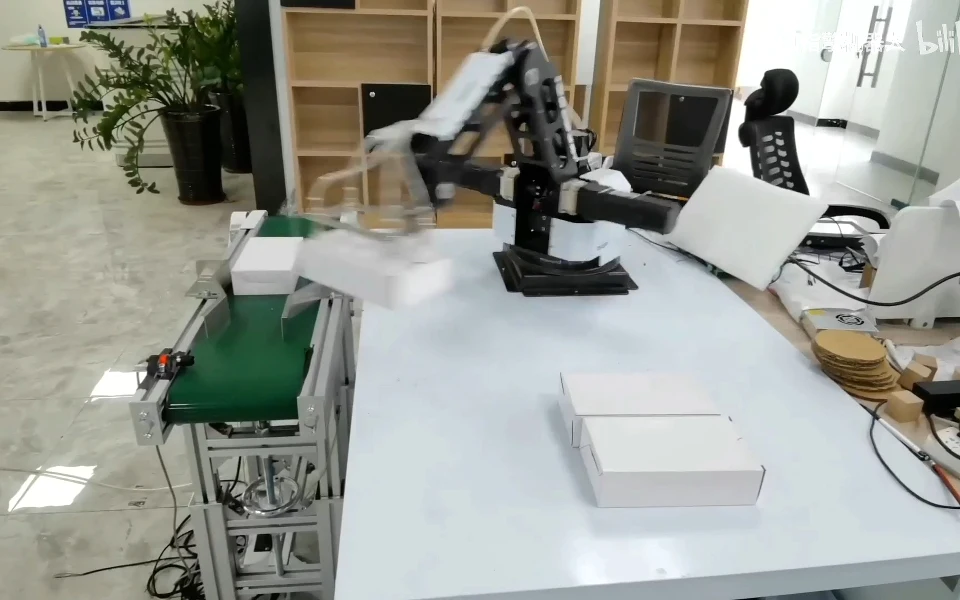
Use one complete handling task as an integration model: an upstream request, acceptance by the robot, motion execution, downstream receipt and release of the next task. Keeping motion, process conditions and communications distinct provides a foundation for adding machines without relying on guesswork after every interruption.
Assign control ownership before selecting the connection
A typical architecture lets the PLC manage station conditions and sequence, the robot controller execute motion, and tools and sensors report material, gripping and position states. Give each action a defined initiating controller and agree who may cancel, reset or take over. Two independent systems should not issue conflicting commands to the same motion task.
“Gripper closed” and “part successfully gripped” are different claims. The first may refer to an output or position indication; the second depends on the tool and part-detection method. Likewise, reaching the placement point does not establish that the receiving station has the component. Give interface signals a meaningful physical definition instead of naming them only “complete 1” and “complete 2.”
Decide what I/O or serial exchange must carry
ZEKEEP's current 3060H industrial specification lists serial and USB-serial communication and 10 digital inputs/10 digital outputs. The standard cabinet documentation for applicable 60H/90H servo models separately lists “serial, Modbus485.” These entries begin an interface discussion; usable commands, wiring and port selection must be confirmed against the chosen robot and cabinet version.
Discrete I/O may suit a small number of clearly defined ready, start, complete and fault conditions. Requirements for recipes, targets or richer state information justify examining available serial commands, data representation and commissioning needs. Listed I/O counts do not establish that every point is freely available for a new application; confirm existing assignments and accessible functions.
The wording “Modbus485” does not establish register addresses, message formats, baud rates or particular read/write functions. A USB connection also does not imply that arbitrary host software can command the robot. Electrical compatibility, port configuration, protocol and application sequence are separate layers that all need resolution.
Give a task explicit transitions and acknowledgements
The following is a proposed PLC or host-application design, not a claim that the controller natively supplies these names or features:
| Stage | What both sides establish | Problem to avoid |
|---|---|---|
| Available | Robot, tool and receiver conditions are satisfied | Starting before the station is ready |
| Accepted | This request has been received and accepted | Treating an unaccepted request as active |
| Executing | Motion and process conditions remain valid | Starting the same task twice |
| Result handed over | Motion and material transfer are confirmed | Calling a taught point a completed handoff |
| Exception retained | Fault and material location are recorded | Restarting blindly from the beginning |
An application task identifier can associate a response with a request, but an identifier alone does not prevent duplicate execution. Define when the task is reserved, how the result is acknowledged and when the request clears. If the device protocol has no identifier field, manage the association in the host application rather than inventing a controller command.
After a timeout, establish whether the action happened
A missing response may mean a command never arrived, or that execution started and the acknowledgement was lost. Resending a pickup can therefore repeat an action. Use available states, agreed signals or controlled operator confirmation before waiting, retrying, removing material or ending the task. Reconnecting communications is not automatically permission to execute again.
Power loss and intervention require the same physical check. Determine whether the part is in the tool, fixture or machine. A completed placement should not repeat because software was reset, while a retained part should not disappear from the task record when a flag is cleared. Ordinary process handshakes coordinate work; personnel safeguarding and hazardous-motion control require an appropriate whole-cell safety design.
Commission in layers that can be checked separately
Verify the robot's independent path and stopping method first, then add the tool and position feedback, PLC requests and results, and finally upstream feeding and downstream equipment. A programming and trajectory demonstration helps explain action organization; a standalone writing exercise does not establish completed industrial machine interlocks.
At each layer, test normal operation and targeted exceptions: missing material, an occupied receiver, lost confirmation and recovery after intervention. Record signal ownership, active levels or data conditions, clearing rules and timeout responses so electrical, robotics and operating teams use the same interface description.
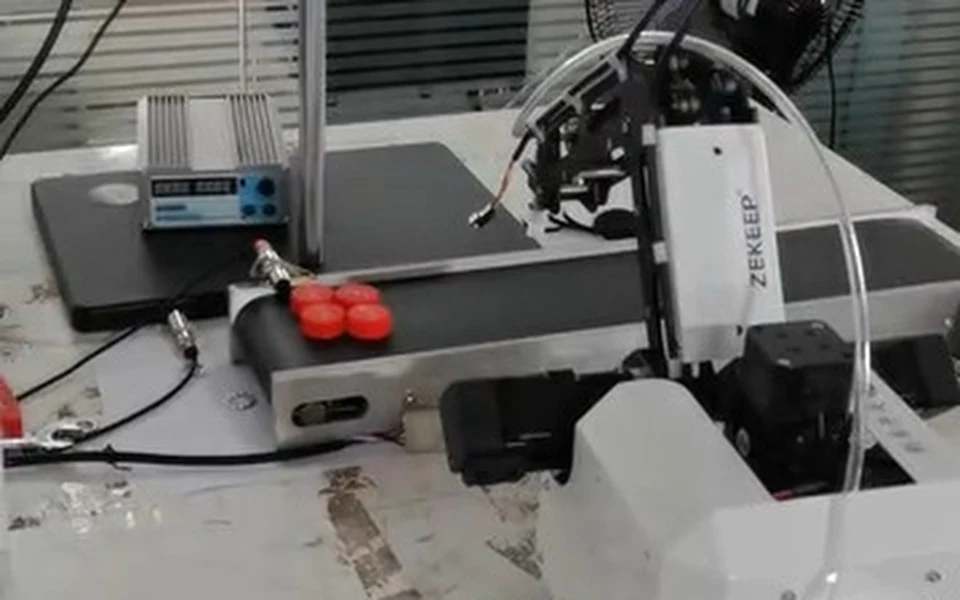
The PCB dual-robot handoff concept illustrates ownership of a shared station. For integration around the 3060H industrial robot, provide interface schedules, architecture, task order, existing program boundaries and recovery requirements. Define the task with ZEKEEP before confirming the protocol and configuration to make development work reusable across the cell.