A mobile robot can report arrival while its arm still misses the workstation reference. This does not necessarily indicate a fault in either navigation or the arm. Map arrival, the chassis's physical pose, the arm's mounting reference and the receiving fixture belong to different levels of the system. Transport becomes a valid manipulation task only when those references agree.
For a mobile manipulator serving several stations, decide which deviations the fixture can accommodate, which require local correction and which require docking again. ZEKEEP's mobile-base and articulated-arm application offers a context for this integration discussion. The actual configuration must follow station tolerance, load and permitted actions.
Trace the reference chain from the site to the tool
A useful description separates the site or map frame, chassis frame, arm-base frame, tool frame and station or part frame. Knowing where the chassis is on a map does not establish the precise part position relative to the arm base.
The arm has a mounting relationship to the chassis. The station-to-chassis relationship, however, changes with the actual docked pose. The grasp target must be expressed in a consistent reference and transformed into a target usable by the arm with its current tool definition. Naming conventions can differ, but the direction, units, source and update time of each transformation should be clear.
If a camera or another local sensor is used, establish where it is mounted, whether it observes the station or the part, and which mechanical changes require recalibration. Adding a correction number independently to every axis is not a substitute for the required rotation and translation relationships.
A small heading error grows at the remote target
Consider an assumed heading deviation of 0.5 degrees and a target approximately 500 mm from the relevant rotation reference. The small-angle estimate for the heading contribution alone is about 500 × 0.00873 = 4.4 mm. This illustrative calculation excludes translation and other errors; it is not a specification for a current product.
A modest chassis-angle change can therefore produce a visible offset at a distant fixture. High arm repeatability does not automatically cancel docking error. Allocate and test the contributions from docking, installation, sensing, tooling and the fixture against the required final acceptance tolerance.
A receiver with generous entry clearance may work with appropriate mechanical guidance. Tighter handoffs may justify controlled mechanical docking, local reference sensing or vision-based correction. Suitability depends on space, environment, parts and maintenance. No one sensing method should be assumed to be standard on every mobile platform.
Add a manipulation permission after navigation arrival
A proposed sequence can distinguish arrival completion, chassis stopped, acceptable docking, station readiness, valid local reference and permission for arm motion. Where stabilizing supports are required, their confirmed condition belongs in the sequence. Whether those supports are needed follows the load and whole-machine design.
Protect the established reference during operation. Chassis movement, a significant external displacement or an out-of-range station reference can invalidate previously calculated targets. Revoke permission and re-establish the required conditions through a controlled process. These are system-level design requirements, not proof that an individual controller already provides complete mobile-manipulator coordination.
Assess whole-machine stability and arm reach together
Extending the arm changes the loading of the complete platform. Selection must consider chassis capacity, center of gravity, permitted extension, floor conditions and actual acceleration as well as tool payload. Reaching a point does not establish that the entire machine should work in that posture. Withdrawal clearance and personnel access also belong in the assessment.
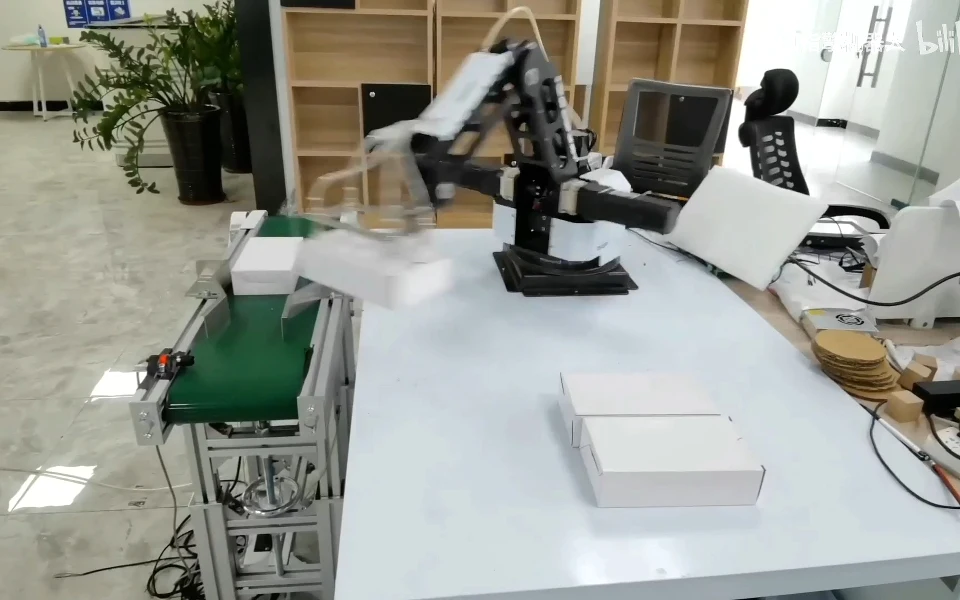
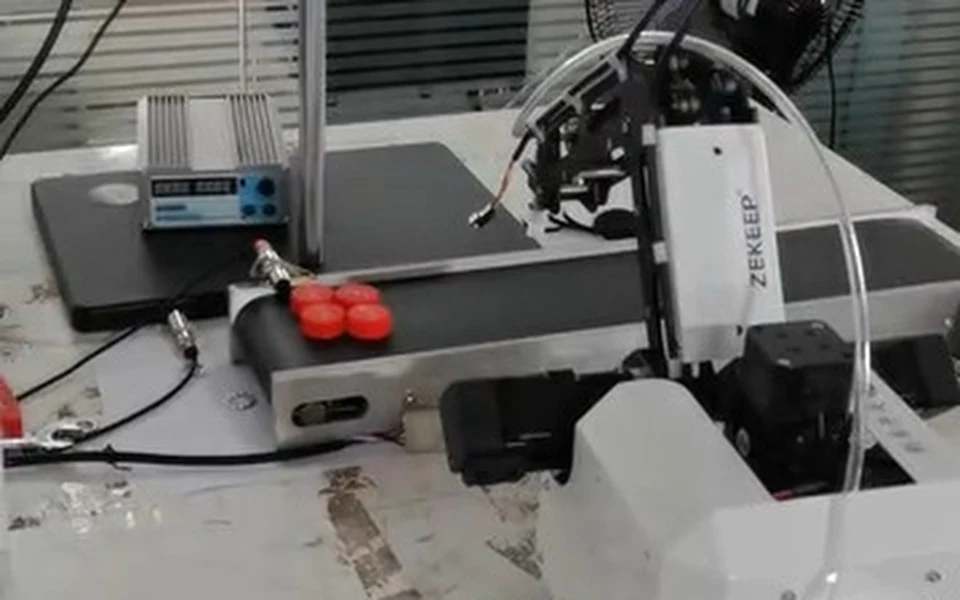
ZEKEEP's MCR mobile manipulator provides a product direction for combining transport and manipulation. Confirm navigation, docking, arm, sensing and control configuration separately for the site. An isolated arm rating is not a specification for the complete mobile system. The roller-conveyor docking and handoff application illustrates a related process arrangement, while each workstation still needs its own coordinate verification.
Test more than one ideal approach
Begin with repeated docking under controlled conditions. Record the physical chassis pose, local-reference result and final tool-to-fixture offset separately. Then vary approach direction, appropriate loads and workstation conditions. Separating angular, translational and tool errors helps identify the component worth improving.
Include a station not ready after arrival, failed local localization, interruption and renewed positioning. Recovery should establish the part location and a safe arm withdrawal before deciding to dock again or continue. The chassis should not depart while an extended arm still depends on the station. Safeguarding and hazardous-motion controls require the whole-machine risk assessment.
For a mobile-manipulator integration discussion with ZEKEEP, provide receiving tolerances, target locations relative to docking, tool and part masses, site geometry and usable reference features. Defining how a trustworthy reference is established after arrival makes navigation, docking and manipulation requirements much easier to compare.