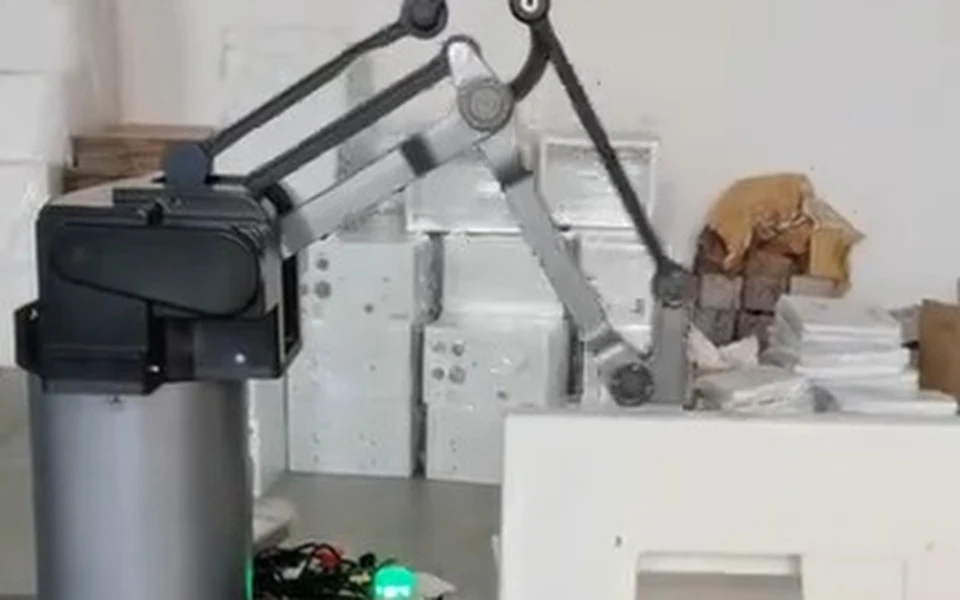
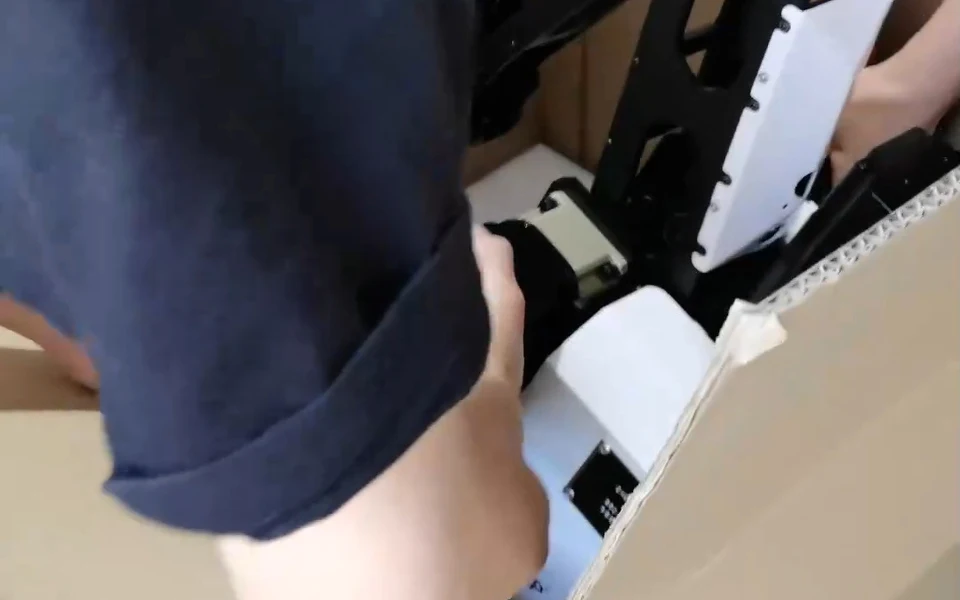
A manufacturer considering a compact robot needs to understand more than the arm itself. Tooling, controls and the workstation determine whether the machine can serve a useful task. ZEKEEP's historical exhibition displays placed several robots and peripheral equipment within one discussion space, turning a specification into a physical basis for questions about parts, machine openings and operation.
Separate exhibition records published by ZEKEEP in September 2021 and June 2023 revisit blue-and-white and orange displays from different periods. Multiple arms, control arrangements and visual information gave visitors tangible starting points for discussing both product structure and practical handling requirements.
Compare complete machines, not just illustrations
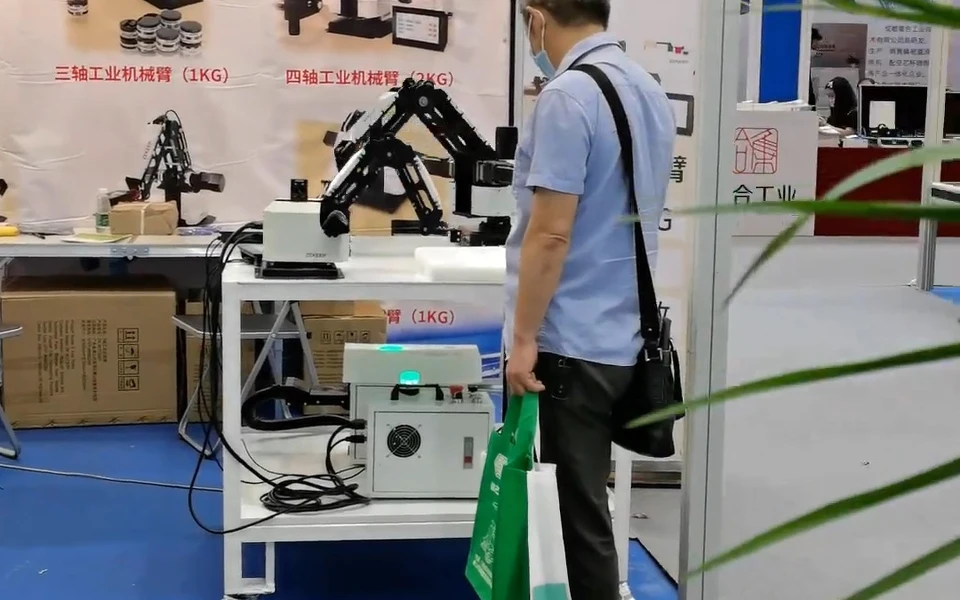
The blue-and-white stand displayed several compact robots on white tables, with product and application information on the backdrop. The stand identification T8/B061 is discernible. Visitors and staff discussed the equipment nearby, bringing the links, bases, tool ends and control arrangements into a tangible presentation.
For a business retaining existing machinery, this format makes installation relationships easier to discuss. Fixed-orientation transfer, end rotation, a long tool or a high receiving point each leads to a different configuration question. Desktop presentation helps explain the product, while actual machine entry, maintenance access and protective space still require a site-specific layout.
Extend the conversation from the arm to perception
The orange ZEKEEP setting included robot samples and a computer vision display, with close views of mechanical connections. Placing perception and manipulation together allows a discussion to cover both how a target is identified and how the end tool approaches, retains and transfers it.
This relates directly to small-part work in areas such as metalworking and electronics. Some tasks require only repeatable transfer from a fixed position; others must first address variation in incoming position or orientation. They justify different configurations. A displayed target image is not proof of a completed defect-inspection task, and vision cannot replace consistent feeding, gripping or a receiving datum. Defined responsibilities provide a more useful basis for the next engineering step.
Turn an application question into usable project information
A common feature of these displays is the ability to discuss mechanics, control and peripherals around the same component. A prospective customer may arrive without a complete automation specification. The initial issue might be repetitive manual pickup or the need to find positions again after a product change. Relating that problem to the tool, path, image and handoff helps determine what should be tested first.
Exhibition discussion does not replace site engineering, but it can shorten the distance between understanding a product and describing a requirement. Follow-up work should establish part dimensions and contact areas, machine sequence, cycle requirements and installation constraints before selecting a standalone cell, vision assistance or a broader integration. Adding every demonstrated function is not necessarily the best investment.
A useful follow-up brief separates essential tasks from options: whether the part must turn, whether the feeder can establish a datum, and whether the receiving machine provides a usable ready condition. This keeps product comparison tied to the manufacturer’s process rather than an equipment checklist.
Use current products to address current manufacturing needs
The historical samples should not be assumed identical to current models. For a present project, the 3060H three-axis servo robot and 4060H four-axis servo robot provide entry points for comparing axes, payload and working range, followed by task-specific tooling and controls.
The reflective-round-part sorting concept develops the relationship between imaging and physical handling. To progress a similar application discussion, bring components, a workstation drawing and the operational problem that matters most when talking with ZEKEEP. Starting with a real requirement turns a machine presentation into an automation proposal with defined next checks.