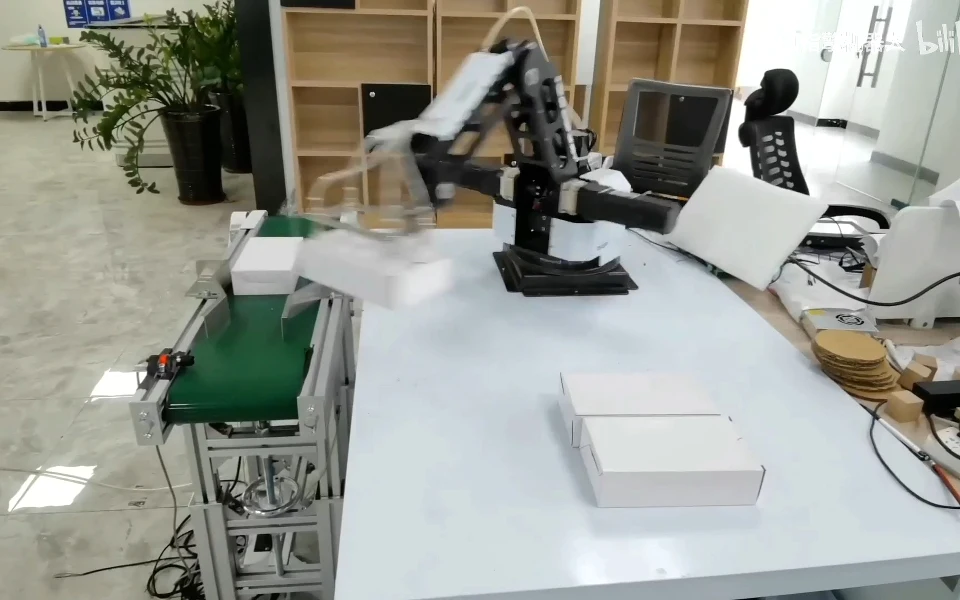
One robot places a part on a scale, another prepares to remove it, and the system receives a weight value. Which part does that value describe? Is it stable? Has the tool fully released the load? Without clear answers, robots can reach every taught position and still route a part using the wrong result.
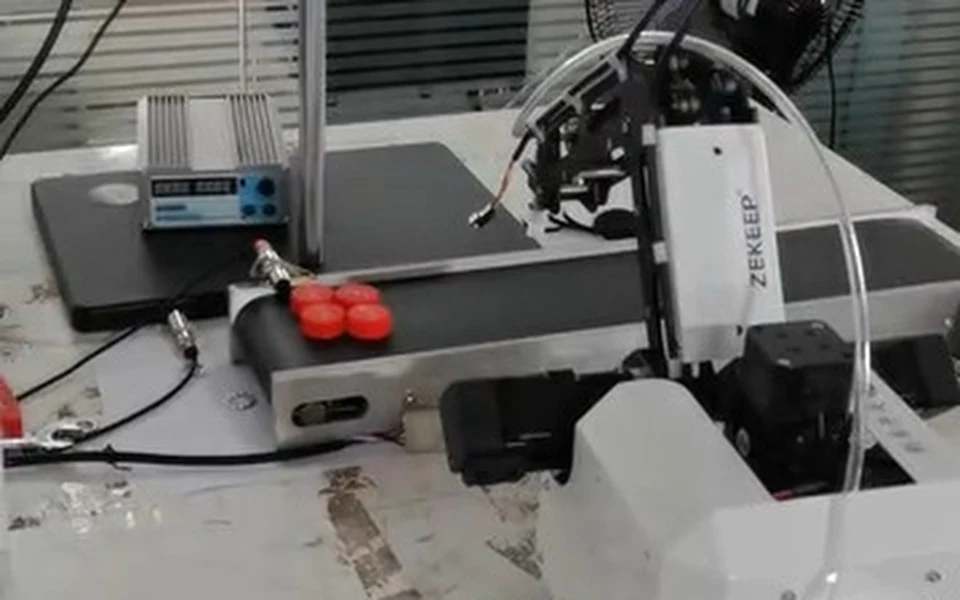
Multi-robot integration needs ownership of information as well as movement coordination. ZEKEEP's PCB-transfer and desktop scale-handling applications provide separate contexts for neighboring-station handoffs and scale loading. Both benefit from explicit state management, but weighing adds two questions: when is a result valid, and which item owns it? Handling repeatability is not weighing accuracy.
Assign shared-space ownership before scheduling entry
An intermediate fixture, conveyor handoff or scale pan should have an identifiable owner: the requesting task, the device currently using it and the conditions for release. Two robots seeing an empty destination does not mean both may enter the same volume.
One proposed implementation uses a coordinator to grant exclusive process access and transfers that permission only after the previous device is clear. Release should follow actual withdrawal and station conditions, not a timer alone. Entry requests, timeouts and exceptions need one understandable policy to avoid devices waiting indefinitely for each other.
This is application-level coordination implemented through the selected robots, PLC or other control system. Ordinary occupancy information supports process sequencing; it does not replace safety-related controls for overlapping robot motion and personnel access.
Establish that the scale carries the complete part
Before measurement, the part must be supported by the scale pan without force from a gripper, suction tool or another support. A released tool may still press on the part, tubing may contact the scale, or a neighboring mechanism may carry part of the load. The reading would then represent more than, or less than, the intended component alone.
Consider bench vibration, movement nearby, airflow and placement impact. Waiting a fixed period after robot withdrawal may support a simple demonstration, but it does not establish a valid measurement under every condition. Define stability and timeout behavior using the selected scale's outputs and the process requirements.
A stability flag can be used after its meaning is confirmed. A rule based on variation across successive readings needs an agreed sample window, tolerance and operating range. Representative samples and the site must establish those conditions. Without measurements, a claimed accuracy or settling time would be unjustified.
Attach each result to an item and a measurement event
A proposed task record can identify entry onto the pan, permission to measure, a valid result, classification and departure. Associate the weight with the current item and acquisition event. The instrument's most recent value is not automatically a newly completed measurement for the present part.
For a digital interface, verify update behavior, units, status information and invalid-value conventions. For discrete classification signals, establish when classification becomes valid and when it is withdrawn. Actual protocol and instrument functions must be confirmed rather than assumed from a system diagram.
On timeout, invalid data or an out-of-range condition, preserve the item identity and location before waiting, reviewing or diverting it. The unloading robot should not reuse the previous classification. Retransmitting a message should not cause a second removal or duplicate completion record.
Close the cycle after removal
The receiving area must be ready and scale-removal permission valid before the unloading robot enters. After departure, verify the empty-pan and next-acquisition conditions appropriate to the configuration. Where tare or zero checks are required, follow the instrument's requirements; repeated automatic zeroing should not conceal residue or drift.
Commission in layers: establish physical load support first, test measurement and classification separately, and then add robot and conveyor coordination. This helps distinguish measurement fluctuation, tracking errors and motion conflicts instead of changing coordinates and classification thresholds simultaneously.
Match equipment to its own responsibility
For light parts with a fixed tool direction, assess the 3060H three-axis servo robot, rated at 2 kg with a 497 mm maximum working radius. Where planar rotation is required, compare the 4060H four-axis servo robot, rated at 1 kg with a 592 mm maximum working radius. Validate complete tool loading, offsets and the route. Weighing range, resolution and achieved accuracy belong to the scale and complete measurement process, not the arm's positioning specification.
Trials should include representative masses, delayed readings, receiver pauses, exceptions and interrupted-cycle recovery. Record item identity, result and final destination together. The PCB single- versus dual-robot cell discussion provides a related handoff-layout example.
For a multi-device weighing-transfer discussion with ZEKEEP, provide the material range, weighing and classification requirements, instrument interface and station actions. Establishing information and spatial ownership first gives a sounder basis for choosing robot count and layout.